How to Scale a Private Label Coffee Brand: Overcoming Production and Operational Bottlenecks

The private label coffee market is experiencing unprecedented growth, driven by commercial demand for specialized, artisanal blends. However, many promising startups fail during the critical transition from low-volume roasting to high-volume commercial supply.
Scaling a coffee brand is rarely just a matter of roasting more beans. It requires strategic investments in production automation, supply chain stability, and rigorous quality control protocols.
Without a robust operational framework, increasing volume often leads to compromised quality, inflated labor costs, and diminished profit margins.
Overcoming Initial Production Bottlenecks
When scaling a private label coffee brand, the transition from manual packaging to automated systems is often the most critical hurdle. Manual or semi-manual processes are plagued by severe inefficiencies that stifle commercial growth.
Operators relying on manual labor frequently encounter inconsistent fill weights, drastically slow output rates, and prolonged oxygen exposure, which rapidly degrades bean freshness.
To meet commercial demands without sacrificing bean freshness, roasters must upgrade to commercial-grade automation.
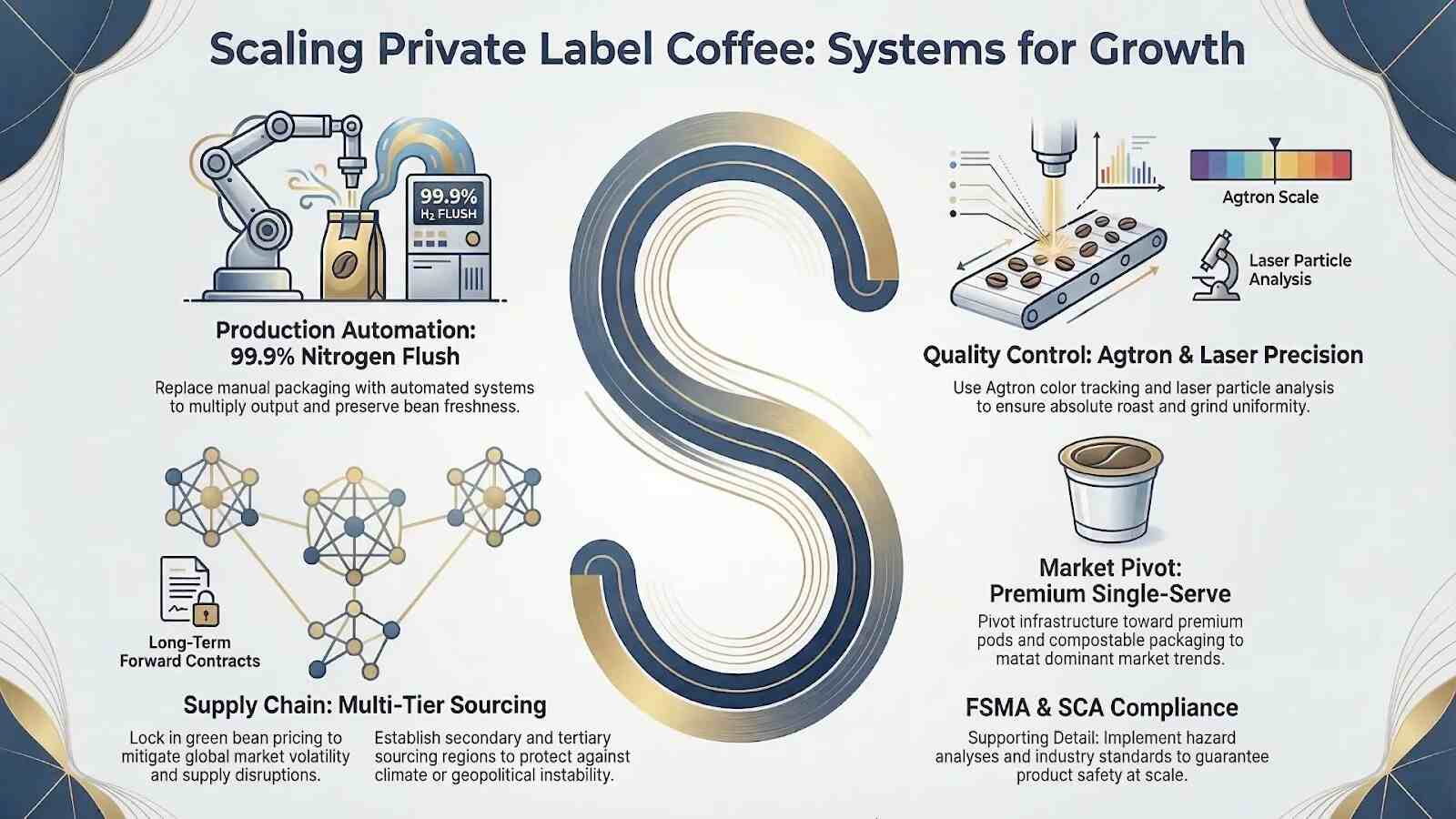
Implementing a high-precision SANEU allows facilities to significantly multiply their output while maintaining exact weight accuracy and utilizing nitrogen flushing (often up to 99.9%) to preserve the coffee’s aromatic profile.
This critical hardware upgrade transforms a labor-intensive operational bottleneck into a streamlined, high-margin production center.
Optimizing the Supply Chain for Raw Materials
Securing a consistent supply of high-quality green beans is vital for any growing B2B coffee enterprise. As production volumes increase, so does the facility’s exposure to global market volatility and supply chain disruptions.
Operators must establish direct trade relationships or partner with established commercial importers to mitigate the risks associated with sudden price fluctuations.
Effective supply chain management requires diversifying sourcing regions to protect against climate-related shortages and geopolitical instability.
Key strategies for optimizing raw material sourcing at scale include:
- Negotiating long-term forward contracts to lock in green bean pricing.
- Implementing inventory management software to track lot numbers and green bean aging.
- Establishing secondary and tertiary supplier networks to prevent sudden production halts.
The Shift Toward Sustainable Packaging
In the modern B2B landscape, commercial clients and end-consumers increasingly demand environmentally responsible products. This shift has made sustainable packaging a core operational requirement rather than an optional marketing feature.
Brands are rapidly transitioning toward compostable, biodegradable, or highly recyclable pods and flexible packaging materials.
While eco-friendly materials may introduce higher upfront costs, selecting the right packaging directly impacts long-term operational viability and contract acquisition.
Operators must carefully balance these material costs with the structural integrity required to maintain the oxygen barrier essential for a prolonged commercial shelf life.
Implementing Strict Quality Control (QC) Protocols
For a private label manufacturer, batch consistency is the absolute lifeline of the brand. Commercial clients expect the exact same flavor profile, roast degree, and extraction quality in every single bulk order.
Failing to deliver uniform quality across large volumes can result in canceled B2B contracts and permanent brand damage.
Scaling requires moving away from subjective tasting and adopting heavily data-driven quality control (QC) protocols.
A standardized commercial QC framework should include:
- Agtron color tracking to ensure precise roast degree uniformity across all batches.
- Laser particle size analysis to guarantee highly consistent grind profiles for different brewing methods.
- Routine cupping panels are strictly calibrated to industry baseline standards.
Furthermore, manufacturing food products at scale necessitates strict regulatory compliance. Facilities must adhere to FDA standards, implement FSMA-compliant hazard analyses, and follow SCA (Specialty Coffee Association) guidelines to guarantee product safety.
Aligning Production with Consumer Market Trends
Scaling operations successfully means anticipating where the market is moving, rather than reacting to where it has been. Operators must ensure their production lines are agile enough to handle emerging product categories and formats.
The modern coffee landscape is currently defined by a massive shift toward premium, single-serve formats and specialty at-home brewing experiences.
To remain competitive, brands must align their production capabilities with broader market data. Recent industry shifts highlight a permanent increase in demand for premium, single-serve coffee formats.
According to recent global coffee market reports, the convenience and consistency of pod-based systems continue to dominate consumer preferences, forcing specialty roasters to pivot their packaging strategies to capture this lucrative demographic.
Investing in adaptable manufacturing infrastructure allows B2B brands to capture these high-margin segments efficiently without completely retooling their factory floors.
Key Takeaways
| Area | Key Takeaway | Impact/Data |
| Production | Automate packaging systems | Enables 99.9% nitrogen flushing |
| Sourcing | Execute forward contracts | Locks in green bean pricing |
| Quality Control | Deploy Agtron & laser analytics | Secures B2B batch consistency |
| Product Strategy | Pivot to single-serve pods | Captures high-margin segments |
Conclusion
Transitioning from a boutique roaster to a scaled private label supplier is a complex operational challenge. Success depends heavily on eliminating manual bottlenecks, securing a resilient supply chain, and maintaining unwavering batch consistency.
By investing in commercial-grade automation and aligning factory output with data-backed consumer trends, operators can build a highly resilient and profitable B2B coffee brand.