Car buying does something strange to people. They get there and the car is sitting in the driveway looking clean and the seller comes out and shakes their hand and suddenly all the careful thinking from the night before feels a little unnecessary. The car is right there. It looks fine. Let’s just see how it drives.
So they walk around it once. Sit inside. Take it around the block. Hand over the money.
For a lot of people that works out. But for a lot of others the problems show up later, three weeks in or three months in, as a repair bill that changes the whole math of what they thought they were getting. And the frustrating part is that most of those problems were already there at the time of the sale. The car wasn’t hiding them. Running a cheap Carfax before the visit catches the documented history, the accidents that went through insurance, the title brands, the odometer entries before you’re standing in someone’s driveway trying to look like you know what you’re doing.
There’s a strange pressure that comes with buying from a private seller especially. There’s a version of the inspection most people actually do, which is walking around the car trying to look like they know what they’re doing while actually just waiting until it feels okay to stop. Then they stop.
The Paint Tells a Story Most People Walk Right Past
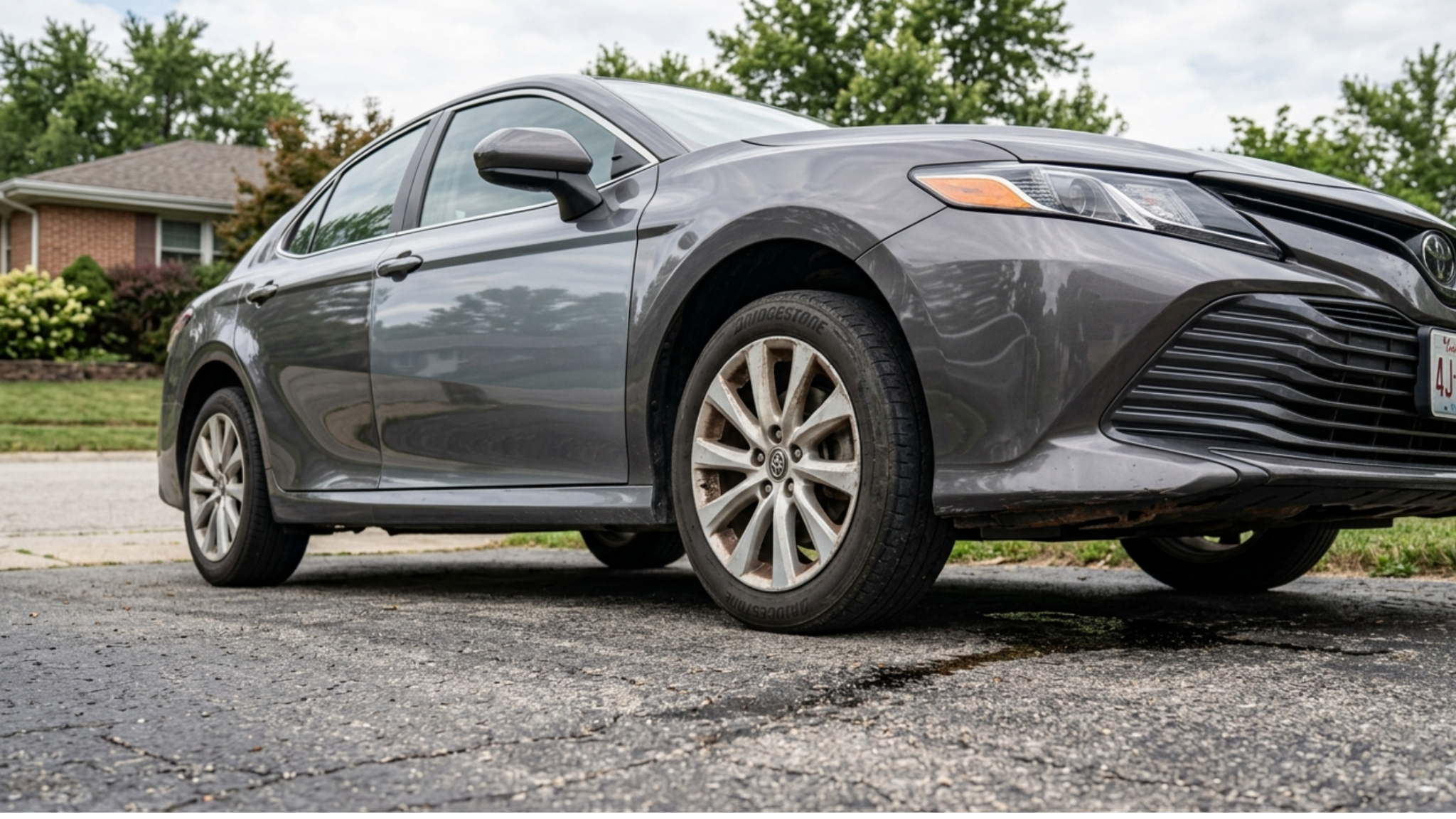
Stand next to a used car in full afternoon sun and look along the side panels from a low angle, almost parallel to the surface. Don’t look at the car straight on. Look along it.
Original factory paint has a particular texture and a particular way of reflecting light. Every panel came out of the same booth on the same day, so they all aged the same way too. A repainted panel didn’t, and that difference is subtle until you know what you’re looking for, and then it’s pretty hard to miss.The reflection has a faintly different quality. Sometimes it’s a touch flatter. Sometimes the orange peel texture, that slight bumpy look all car paint has up close, is a little more pronounced or a little smoother than the panels around it.
Color match is the other thing. Body shops try hard to get it right and modern mixing systems are pretty accurate, but paint fades over time and a fresh paint job on a five-year-old car almost never matches the surrounding panels exactly in direct sunlight. Get to the seam where the door meets the quarter panel and look at both at the same time. In the afternoon sun a panel that was painted separately from the one next to it usually gives itself away, something about the tone is just slightly off in a way that’s hard to name but easy to see once you’re actually standing there.
None of this means the car is ruined. But it means something happened to that panel, and the question is what. A small parking lot scratch is different from a side impact that pushed the door into the cabin. The paint doesn’t tell you which. It just tells you something was done.
Under the Car Is Where the Real History Lives
Getting under a car takes about fifteen seconds and most buyers never do it. They’ll spend twenty minutes on the interior and pop the hood and walk around the outside twice, but the underside just doesn’t make the list. Which works out well for anyone selling a car with frame rust or a leaking differential, because they know most buyers won’t look.
You don’t need to know what you’re looking at in any technical sense. You just need to look.
Rust is what you’re primarily looking for and specifically where it is. Light surface rust on brake rotors or on small brackets is common and normal, especially if the car sat for a few weeks between drives. What’s not normal is rust that’s eaten into the metal of the frame rails, which are the structural beams running the length of the car front to back. Flaking rust on those surfaces, soft spots where the metal has gone thin, these aren’t cosmetic issues. They’re structural ones, and they’re expensive to fix properly when fixable at all.
Look at the subframe while you’re down there. Water sits in the places where metal meets metal and doesn’t move, and the subframe has a lot of those spots. That’s usually where rust starts before it shows up anywhere more obvious. Look at the seams. Look at the mounting points where the suspension bolts to the body. Look at the floor pan above you for any soft spots or rust-through.
Also look for fresh undercoating. Some sellers spray black rubberized undercoating on the underside of a car before a sale because it covers rust. A thick, even application of fresh-looking undercoating on an older car is worth treating with some suspicion, especially if the rest of the car shows its age normally.
Fluids Are Cheap to Check and Tell You a Lot
This takes maybe four minutes and requires nothing but pulling a few caps and dipsticks. Most buyers skip it entirely.
The dipstick takes thirty seconds. Pull it, wipe it on whatever’s nearby, slide it back in, pull it out again. Golden or light brown means someone changed it recently. Dark brown or black means they didn’t, at least not for a while. Neither of those things is world-ending on its own but when a seller spends the drive over telling you how carefully they looked after this car, the dipstick is a pretty quick way to get a second opinion.
The oil cap is worth unscrewing too. Look at the underside. If there’s anything creamy or frothy in there it means coolant is where oil is supposed to be, which means head gasket, which means a conversation you don’t want to be having after you’ve already paid.
That points to a head gasket problem. Head gaskets are not a small repair. A little condensation is normal. Anything that looks like a latte someone made badly is not.
The coolant reservoir, that small plastic tank you can usually see through from the outside, should be a bright color. Green, orange, pink. If it’s brown it’s been sitting neglected long enough for rust to start building inside the system, which is a longer conversation than most buyers want to have.
Same idea with the transmission fluid if the car has a dipstick for it. Color and smell, that’s really all there is to check. Red and neutral means fine. Dark brown and burnt means someone skipped that service for a while, probably more than once. Transmission work is one of the more expensive repairs a used car can handle and the fluid is usually honest about where things are heading before it gets there.
The Test Drive Needs Actual Roads and Actual Time
Ten minutes around a quiet neighborhood tells you almost nothing useful. The car is cold, the transmission hasn’t been working, nothing is under any stress at all. Everything feels fine because nothing has been asked of it yet.
Highway driving is where problems that hide themselves at lower speeds decide to show up. Get it to 65 or 70 and hold it there. Any vibration that wasn’t there before is a wheel or balance issue. Any pull to one side that you’re not causing with the steering wheel is the alignment or something in the suspension that’s worn past where it should be.
Then brake. Actually brake, not a gentle slow-down but a real stop from around 45 mph. It should track straight and feel consistent through the pedal. Pulling sideways means the brakes are working unevenly. A rhythmic pulsing through the pedal on every stop means warped rotors. Neither of those fixes itself.
Turn everything on at some point. AC on max, rear defrost, all the seat heaters if it has them. Roll the windows down and back up. Turn the heated mirrors on. These things work fine sitting in a driveway but can reveal problems once they’re actually running. A compressor that’s struggling makes itself known pretty quickly when it’s asked to cool a hot car on a warm day.
And somewhere during the drive, just turn the radio off and open the windows a crack. The seller has been driving this car for months or years. Any noise it makes regularly, they’ve stopped registering it. You haven’t yet. A rhythmic knock that speeds up with engine RPM, a hiss from somewhere under the dash, a rattle that appears on certain road surfaces, these are things fresh ears catch. Trust what you notice.
The Tires Know Things About the Car’s Alignment
Tires are easy to look at and most buyers check the tread depth, which is fine, that matters. But the pattern of wear across the tire tells you more than the depth does.
A tire that’s been on a properly aligned car with good suspension wears evenly from edge to edge. The outer edge, the center, and the inner edge all wear at roughly the same rate. When that doesn’t happen, something upstream is causing it.
Wear concentrated on the outer edges of the tire, sometimes called feathering, usually means the car has been running with too much negative camber or the suspension geometry is off. Wear on just the inner edge points to the opposite. Center wear usually means the tires have been running overinflated for a long time. One shoulder worn down more than the other means something in the suspension or steering is bent or worn, a control arm, a tie rod, something that’s been pulling the tire out of position every mile since it happened.
Sometimes that’s a cheap alignment fix. Sometimes it’s not. Either way the tires already told you about it before the mechanic did.
What Doesn’t Get Fixed Because It Isn’t Visible
Here’s what happens with a lot of accident repairs. The body shop fixes what you can see. The bumper cover, the fender, the door, whatever panel took the impact. They repaint it, they align the gaps as well as they can, and from the outside the car looks normal.
What they don’t always address is what the impact did further back. Metal transfers force. A hit to the front corner of a car doesn’t stay in the front corner. It moves through the structure. The radiator support sometimes takes a hit that nobody bothered to straighten because it’s not visible once everything is reassembled. Same with the strut tower, the thick reinforced section where the front suspension bolts to the body. Neither of these shows up in photos.
These aren’t always visible from a walk-around and they’re not always repaired because the job was written to fix what the insurance adjuster could photograph.
The firewall is the most telling of these. It’s the vertical panel separating the engine bay from the passenger cabin. In a significant front-end collision, the firewall absorbs some of what the bumper and engine bay couldn’t. Look at it when you have the hood open. Look at the corners where it meets the inner fender panels. Paint that’s cracked along a fold, metal that’s moved slightly in a direction it wouldn’t move on its own, these things don’t happen from age or weather. Something pushed them there.
None of this shows up in photos. Most of it doesn’t show up in a VIN report either, especially if the repair was paid out of pocket without an insurance claim. You find it by looking at the actual car in the actual daylight with the hood actually open. But the repairs that did go through insurance, the ones that left a paper trail, those show up in a cheap Carfax and knowing about them before you drive out changes what you’re looking for when you get there.
The Seller’s Behavior Is Also a Detail
This one doesn’t get mentioned much but it’s worth paying attention to.
A seller who knows their car well will answer specific questions specifically. They’ll tell you when they had the oil changed last, roughly what mileage the tires are at, whether anything has been repaired and by which shop. They might not remember everything perfectly but the general shape of an honest answer is different from an evasive one.
“It’s been well maintained” without anything behind it is not an answer. “I always took it to the dealer” is slightly better but still vague. A person who’s looked after their car usually knows the rough details without having to think too hard. The ones who get vague when you ask something specific are either genuinely unsure or quietly hoping the conversation moves on.
Bring up the independent inspection at some point and just watch how that lands.
Most honest sellers say fine, no problem, they understand. The ones who get uncomfortable, who say the inspection isn’t necessary, or who push back on the idea of taking it somewhere else, are usually uncomfortable for a reason.
Rushing is another sign. If the seller keeps bringing up other interested buyers or mentions twice that they expect it to go fast, that’s not small talk. Good cars sell on their merits. A seller who needs you to decide today, before you’ve had a chance to have it properly looked at, is a seller whose car probably doesn’t hold up well under scrutiny.
Small Things That Seem Minor But Add Up
The horn. Almost nobody tests the horn. Press it. If it doesn’t work, that’s a failed inspection in most states and a question about what else hasn’t been checked.
Every window, all the way down and all the way back up. It takes thirty seconds and window regulators are the sort of thing that works fine right up until it doesn’t, usually at the worst possible time.
Same with the latches, trunk and hood both. Open and close them a few times. A latch that hesitates or needs a push to fully catch is already telling you something, whether it’s age or a minor hit somewhere along the way.
Lock and unlock every door. Inside handle, outside handle, key fob if there is one. Older cars lose door locks one at a time and nobody ever notices until they’re standing in a parking lot in the rain trying to get in through the passenger side.
Check every single light. Headlights on low and high beams. Taillights. Brake lights, which requires someone standing behind the car while you press the pedal, or backing up to a wall and watching the reflection. Turn signals front and back. Reverse lights. These are all things that fail on used cars and all things that get flagged in an inspection.
None of these checks takes long. The whole list of small stuff probably adds ten minutes to the time you’re spending with the car. But it’s ten minutes that tells you whether the car has been driven by someone who noticed when things stopped working, or by someone who learned to live with things not working and then handed that to you.