In the marine, aquaculture, and waterfront development sectors, the importance of adaptable and reliable infrastructure cannot be overstated. As modern marine facilities and docking areas develop, pontoon docks are among the most efficient, safe and sustainable docking solutions. Partnering with a reputable floating dock manufacturer enables B2B companies to purchase high-quality performance dock systems, creating long-term value at a lower upkeep cost with reduced ecological disturbance.
This article identifies the main benefits of pontoon docks for commercial marinas and waterfront activities focusing on performance, extensibility, and all-round commercial use ecological benefits.
Pontoon Docks for Contemporary Waterfront Developments
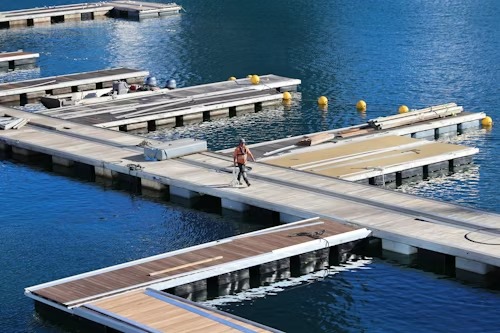
Pontoon docks, or floating dock systems, are a variety of modular structures that are designed to remain buoyant and level regardless of the water level. Unlike fixed docks that are secured to the ground with permanent pilings, pontoon docks are free floating and can rise and fall independently, providing stability and access regardless of the tide or season.
Constructed with materials like high-density polyethylene (HDPE), aluminum, or reinforced concrete, pontoon docks have remarkable resistance against corrosion, UV rays, and severe marine conditions. Their versatility and modulatity makes them useful as docking stations for vessels and as working platforms for aquaculture, maintenance, and logistics.
Moreover, they are increasingly incorporated with floating fish cages and aquaculture systems, enhancing the supporting operations for feeding, harvesting, and monitoring. This versatility makes pontoon docks a practical solution for both industrial and environmental applications.
Superior Durability and Longevity
Pontoon docks are a good long term investment for commercial operators, as their durability is outstanding. Built for heavy use, these docks can endure vessel impact, temperature extremes, and saltwater corrosion, and hold their structural integrity.
When developed by a top-tier floating dock manufacturer, pontoon docks can be the best option, as they merge marine-grade materials with accurate engineering. Great service life with low maintenance is assured by reinforced connectors, UV protected components, galvanized fasteners, and other top-grade docks.
Operators have reported lower long term costs invested on pontoon docks, as with regular maintenance and inspection, they can last over 20 years. This makes pontoon docks an excellent infrastructural choice for ports, aquaculture, and marinas.
Flexibility and Customization
No two projects along the water are the same. Pontoon docks have the most flexibility and can adapt to varying business requirements.
Modular and Scalable Design
Businesses can alter the configuration or expand the docks by adding more modular units. This flexibility allows businesses to adapt the layouts for different sizes of vessels, increase the capacity, or add new zones with no major reconstruction.
Custom Features and Integration
Custom features like non-slip surfaces, safety railings, and lighting systems can be integrated to make the docks more user-friendly and safe. Utility channels for water and fuel, or electricity can be integrated within the dock’s structure, enhancing the operations of the marina.
Industrial clients can integrate storage units, workstations, or loading cranes, and aquaculture operators can add their fish feeding or monitoring systems. The perfect blend of operational customization with aesthetic design is ensured with the docks.
Low Maintenance and Cost Efficiency
Due to their structure, pontoon docks are designed for very low maintenance. Considering the weathering, corrosion, and upkeep of traditional fixed docks, this design is a breath of fresh air.
Since the materials are corrosion resistant, and the structure is buoyant, there is no need for heavy underwater repairs. Routine maintenance is low, mostly consisting of cleaning, checking different dock components, and replacing connectors when needed. This keeps operation downtime to a minimum and saves labor costs.Marinas are provided with uninterrupted services while customers are provided with services that are uninterrupted and exceed expectations. In industrial facilities, it provides additional other operational cost efficiencies with seamless functionality.
Stability and Safety
Apprehension of the pontoon dock system is their most valued trait. Even with changing conditions of water, their design is stable, allowing for secure access for the users, and for the equipment and vessels.
Key features that enhance safety includes:
- Decking that is anti-slip so that one can retain better traction
- Injuries are prevented with rounded edges and reinforced joints
- Weight distribution is kept even for easy load transfer and high traffic.
Floating docks are designed to be stable, allowing their use in commercial marinas or for industrial work platforms. Custom safety features such as guardrails, edge protection, and alteration of illumination to LED are to help enhance safety and visibility, and to fulfill safety obligations in work activities.
Safe Infrastructure with Sustainable Impact
Sustainability is becoming a key factor as a guiding principle in marine construction. Marine construction aligns with the eco-friendly business principles of low impact installation, as well as the construction of pontoon docks.
Construction of Eco-Friendly Materials
Construction of most pontoon docks uses and construction uses HDPE or aluminum, both of which are recyclable, non-toxic, and eco-friendly. HDPE also helps in the control of water quality in marinas, and in environments for aquaculture, as it resists the growth of algae.
Reduced Environmental Impact
Floating docks are built without the need for underwater foundations or pilings, further decreasing devastation to marine environments. Anchor systems are engineered to allow natural water-flow, which sustains the life below the surface.
Supporting Sustainable Aquaculture
Officials pair pontoon docks withfloating fish cages and other aquaculture gear to foster operational expansion while decreasing ecological impacts. Their modular design complements aquaculture, furthering responsible marine development.
Wide-Ranging B2B Applications
Pontoon docks have far-reaching flexibility, allowing them to be used in multiple sectors besides the usual marinas.
Marinas and Ports
Pontoon docks enable marinas to offer safe berthing and hassle-free boarding for vessels of all sizes. Operators are able to modularly configure these docks, making them easily expandable to accommodate changing demand.
Aquaculture and Fisheries
In aquaculture, pontoon docks are used as robust workstations for feeding, monitoring, and harvesting. Their flexibility and corrosion resistance make them multifunctional for saltwater or freshwater applications.
Industrial and Commercial Platforms
Pontoon docks serve as floating workplaces for inspection, maintenance, and construction in all industrial sectors. They are able to support large amounts of personnel and heavy equipment, providing a stable base that can be moved easily to suit changing project needs.
Floating Commercial Venues
Pontoon docks also function as foundations for floating eateries, exhibition spaces, and platforms for events. The combination of strength and design flexibility opens up new possibilities for businesses to engage with the waterfront.
Selecting the Most Suitable Floating Dock Manufacturer
Your relationship with floating dock manufacturers will determine the quality and value your business can derive in the long run. It is important for B2B companies to take into consideration the following factors when choosing a supplier:
- Experience in the execution of large marine works.
- Freedom to decide on the arrangement of components, the design of the buoy, the materials used, and the load to be carried.
- Value as seen through some quality international endorsements such as ISO, CE, SGS, etc.
- Commitment to After-sales services like tutorial installation and maintenance.
- Responsibility for the environment during and after the production process.
You will receive full assistance from your floating dock manufacturer to design docking spaces that adhere to standards in safety, environment, and service responsiveness.
Conclusion
The combination of pontoon docks’ durability, flexibility, and sustainability is revolutionizing waterfront infrastructure. They offer long-term performance and versatility for marinas, aquaculture, and industrial sites.
Pontoon docks are the modular solution for docking vessels, integrating floating fish cages, and creating industrial work platforms. They stand as a progressive value in marine infrastructure to help businesses achieve a professional floating dock manufacturer.
As a result of engagement and overcoming the challenges of innovation, sustainability, and operational excellence, investing in pontoon dock systems in the competitive B2B marine environment portrays a new direction with a focus on strategic decision making since the marine industry is currently more competitive than ever.