Scaling a Premium Private Label Brand: The Strategic Role of Custom Packaging

The private label market in 2026 is more crowded and competitive than ever before. For emerging ecommerce founders and established FMCG businesses, simply offering a functional product is no longer enough to secure market share. Today, packaging serves as the physical embodiment of your brand.
It is no longer just a mere container for shipping and storage. Instead, packaging has evolved into a core component of brand equity, customer retention, and overall market positioning. Choosing the right packaging strategy is a fundamental business decision that impacts everything from consumer psychology to supply chain efficiency.
Why Material Choice is Your First Crucial Decision
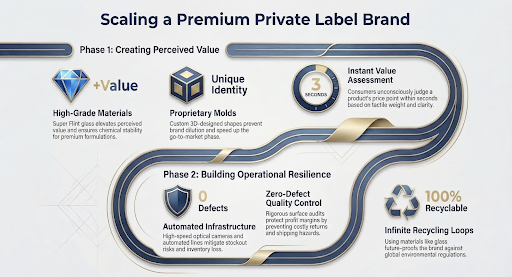
The physical touch, weight, and visual clarity of your packaging directly dictate the retail price you can successfully command. Consumers unconsciously assess the value of a product within seconds of picking it up. Premium products require superior, high-grade materials to justify a luxury price tag, rather than relying on standard, lightweight plastics that can dilute brand perception.
When launching premium product lines such as cosmetics, bespoke fragrances, or artisanal beverages, the tactile experience of the container is just as important as the product itself. Utilizing high-clarity materials—like the Super Flint Glass produced by specialized manufacturers such as Nuvole—can significantly elevate a product’s perceived value on the shelf while ensuring chemical stability for sensitive liquid formulations.
Evaluating Manufacturing Partners: Capacity vs. Quality Control
Choosing the right B2B packaging supplier is critical to your brand’s operational success. A partner must offer more than just low unit costs; they must demonstrate reliable infrastructure. When vetting potential manufacturing partners, supply chain managers should evaluate the following criteria:
- Production Scalability: Can the facility handle sudden surges in demand without compromising quality?
- Technological Infrastructure: Do they utilize modern, automated inspection equipment?
- Material Sourcing: Are their raw materials consistent, traceable, and compliant with international standards?
- Communication Protocols: Is there a dedicated account manager providing transparent updates on production milestones?
The Importance of In-House R&D and Custom Molds
Relying heavily on generic, off-the-shelf molds is a quick way to blend in with your competitors and dilute brand identity. To truly stand out, businesses must invest in proprietary packaging shapes that align with their distinct brand narrative.
Working with manufacturers who offer rapid custom 3D design and maintain large, well-managed mold inventories is a strategic advantage. This integrated approach drastically speeds up the go-to-market phase, allowing brands to move from concept to mass production with minimal friction.
Lead Times and Supply Chain Resilience
In an era where global instability is reshaping business risk planning, relying on slow or fragile production networks is a massive liability. High-capacity, heavily automated production lines are essential for mitigating the risk of costly stockouts, especially during peak retail seasons.
By partnering with technologically advanced facilities, brands can achieve significantly tighter lead times. Supply Chain Resilience is built by ensuring your manufacturing partner has contingency plans, predictive maintenance protocols, and the robust output capabilities required to keep your inventory flowing smoothly.
The Financial Impact of Flawless Packaging
Overlooking structural integrity during the private label packaging development phase can lead to devastating hidden costs. High defect rates and leakage issues don’t just result in lost inventory; they create shipping hazards, trigger costly product returns, and inflict long-term damage on consumer trust.
This is why rigorous Quality Control is non-negotiable. Top-tier manufacturers employ multiple rounds of surface inspections at the factory level—often combining high-speed optical cameras with manual audits. Ensuring flawless packaging at the source protects your profit margins and preserves your brand’s reputation.
Aligning Packaging with Global Sustainability Standards
Modern supply chains are facing increasing pressure to minimize their carbon footprint. By opting for materials that support infinite recycling loops, businesses can future-proof their operations against strict environmental regulations while satisfying the eco-conscious consumer.
In fact, comprehensive glass recycling systems not only reduce raw material consumption but also significantly lower greenhouse gas emissions during the manufacturing process, making it a highly sustainable choice for long-term brand building. Choosing the right materials is a proactive strategy to mitigate regulatory risks and align with global sustainability benchmarks.
Key Takeaways
| Area | Key Takeaway | Impact/Data |
| Material Strategy | Upgrade to Super Flint Glass | Justifies luxury pricing; ensures chemical stability |
| Brand Identity | Invest in proprietary 3D custom molds | Accelerates go-to-market; prevents brand dilution |
| Quality Control | Mandate automated optical and manual audits | Eradicates costly returns and inventory shrinkage |
| Supply Chain | Partner with high-capacity automated facilities | Eliminates peak-season stockouts; tightens lead times |
| ESG Compliance | Integrate infinitely recyclable glass supply loops | Mitigates regulatory risks; lowers greenhouse emissions |
Conclusion: Packaging as a Growth Lever
Ultimately, custom packaging is far more than an operational expense; it is a powerful growth lever. The materials you choose, the quality standards you enforce, and the partners you select directly influence how consumers experience your brand.
By prioritizing high-quality materials and robust manufacturing partnerships, businesses can secure their supply chains and elevate their market positioning. Investing in the right B2B packaging strategy pays continuous dividends in brand loyalty, operational efficiency, and scalable profitability.