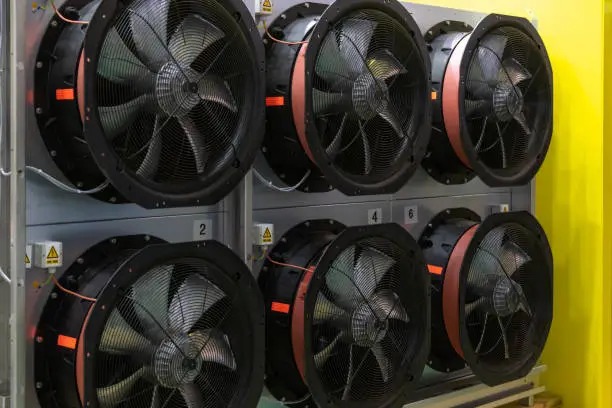
Axial fans offer versatile solutions for the movement of air in industrial and commercial environments and in the implementation of technical solutions. Unlike centrifugal fans, which change the direction of air movement by 90 degrees, axial fans implement air movement in the direction of the fan’s rotational movement. Axial fans enable the movement of large volumes of air at low pressures. B2B companies must understand the design, performance, and applications of axial fans to choose the appropriate axial fan for ventilation, cooling, or industrial processes. This article examines axial fans in detail, including principles of design and types of fans, design applications in the industry, maintenance, and improvement of efficiency.
Understanding Axial Fans
An axial fan uses a propeller or an impeller to draw air along the same axis as the rotation. Such linear air movement is perfect for environments and applications where large volumes of air must be moved quickly like factory floors, data centers, and warehouse ventilation systems. In environments where airflow resistance is low, axial fans will be more energy efficient and cost effective than centrifugal fans, making axial fans ideal for ductless ventilation or open air cooling applications.
Several key factors influence the performance of an axial fan, such as the pitch of its blades, its diameter, the power of the motor, and the speed at which it operates. Appropriate blade design leads to less turbulence and noise, as well as more efficient airflow. Most industrial axial fans have variable speed motors because most industries need to adjust the airflow to more specific amounts, within a range, to meet the changing operational requirements.
For organisations looking to optimise performance, this AC and DC fan product page outlines specifications and other details that can aid in selection for industrial and technical applications.
Design Considerations for Industrial Axial Fans
B2B organisations need to account for a variety of design considerations so that the axial fans meet the operational needs and requirements.
- Airflow Volume and Pressure: While it is true that axial fans can move large amounts of air, the static pressure is usually low. Engineers must reconcile system resistance in order to inefficiently spend.
- Motor Type and Control: The fans can run on AC, DC, or EC motors. For cooling of industrial equipment and electronics, DC motors are a more energy efficient variable speed option, fitting modern operational needs.
- Material and Durability: High temperatures, humidity, and corrosive gases are some factors to consider in an industrial environment. Using appropriate fan materials, that comprise coated metals, stainless steel, and reinforced plastics, will achieve longevity and consistent performance.
- Noise and Vibration: Reducing noise in a server room or workplace is essential. Sound levels are affected by blade design, motor insulation, and mounting methods. The elimination of vibrations is also a must to avoid the waste of operational efficiency and damage to equipment.
Engaging in Advanced Engineering practices may include the use of Computational Fluid Dynamics (CFD) to design optimal fan blade geometry, predict airflow, and reduce turbulence. This confirms that the chosen axial fan performs to its maximum capacity and efficiency while maintaining safe industrial practices.
Applications of Axial Fans in B2B Industries
Axial fans are widely used and versatile in numerous B2B industries:
- Industrial Ventilation: It is a basic requirement in factories, workshops, and warehouses to have regular air circulation to keep working conditions safe and comfortable. Axial fans can efficiently ventilate these spaces by moving large amounts of air without needing complicated duct systems.
- Cooling in Data Centers and Electronics: Electronics, servers, and storage systems must be kept at optimal temperatures. Axial fans can reduce the temperature of sensitive components by creating high-volume airflow, which eliminates the overheating risk and prolongs the equipment’s life.
- Agricultural and Greenhouse Applications: High-capacity axial fans provide consistent environmental control and optimize the benefits of temperature, humidity, and air quality distribution, encouraging livestock and greenhouse health and growth.
- HVAC Systems: Particularly in lower-pressure air circulation systems, axial fans in air handling units, roof ventilators, and cooling towers alleviate the challenges of moving air in large volumes, achieving the desired efficiency.
- Transportation and Marine Industries: In confined spaces of vehicles, ships, and trains, axial fans are essential for engine cooling, cabin ventilation, and exhaust systems due to their compact build and ability to move large volumes of air rapidly.
The adaptability of axial fans makes them indispensable in any B2B business that has to manage airflow and its control. In many instances, ACDC FAN for industrial or electronic cooling targets airflow control, dependable performance, and reliability at a wide range of operational speeds to provide flexibility and energy efficiency.
Types of Axial Fans
Axial fans are differentiated in their blade design, casing, and the needs of the application.
Vane-Axial Fans have additional guide vanes that help in streamlining the airflow which further increases the static pressure. These types of fans are best used in longer duct systems or systems with moderate-resistance applications.
EC Axial Fans, or DC Axial Fans, are powered by commutated electronics or DC batteries and provide the ability to control the airflow with higher efficiency while simultaneously quieting the fan. This is important in reducing ambient noise in industrial applications and for electronics cooling.
Each operational context, blade shape, size, and motor also need to be tailored for the requirements. Long blades that spin at a lower speed are used for ventilation in the open air, while short blades rotating at a high speed are used for enclosed cooling of electronics.
Properly planned and executed maintenance involves fans downing the least operational time and kept in an effective range of efficiency.
Dust that settles on the fan or motor assembly must be removed to prevent an imbalance and compromised efficiency. It is also recommended to provide the fan bearings with planned maintenance of lubrication to avoid bearing seizure.
Alignment and mounting must be kept in check to avoid unbalanced rotation, which causes noise and vibration, and the motor and supports to become damaged.
Airflow control, pressure, and temperature monitors provide operational oversight that identifies maintenance opportunities to avoid unplanned operational system failures.
In industrial settings, optimizing efficiencies drives down costs. Incorporating variable speed drives, high efficiency motors, and optimized blade designs aid in conservatively using energy while providing the necessary airflow. The energy savings enjoyed with DC and EC axial fans are remarkable. These fans precisely control their speeds according to real-time requirements, meeting operational needs while avoiding providing excess airflow, thus saving wasted energy.
Conclusion
Axial fans are crucial to B2B businesses needing dependable, high-volume airflow for industrial, commercial, and electronics applications. Learning the fans’ designs, different types, their uses, and maintenance weighs a business’s operational costs. Thoughtfully designed and installed axial fan systems enhance safety, energy savings, equipment durability, and operational efficiency. For detailed performance expectations and high-performance AC/DC solutions, https://www.acdcecfan.com/es/products/ac-radial-fan, and look for models that fit your needs for heavy-duty industrial and electronic cooling applications.