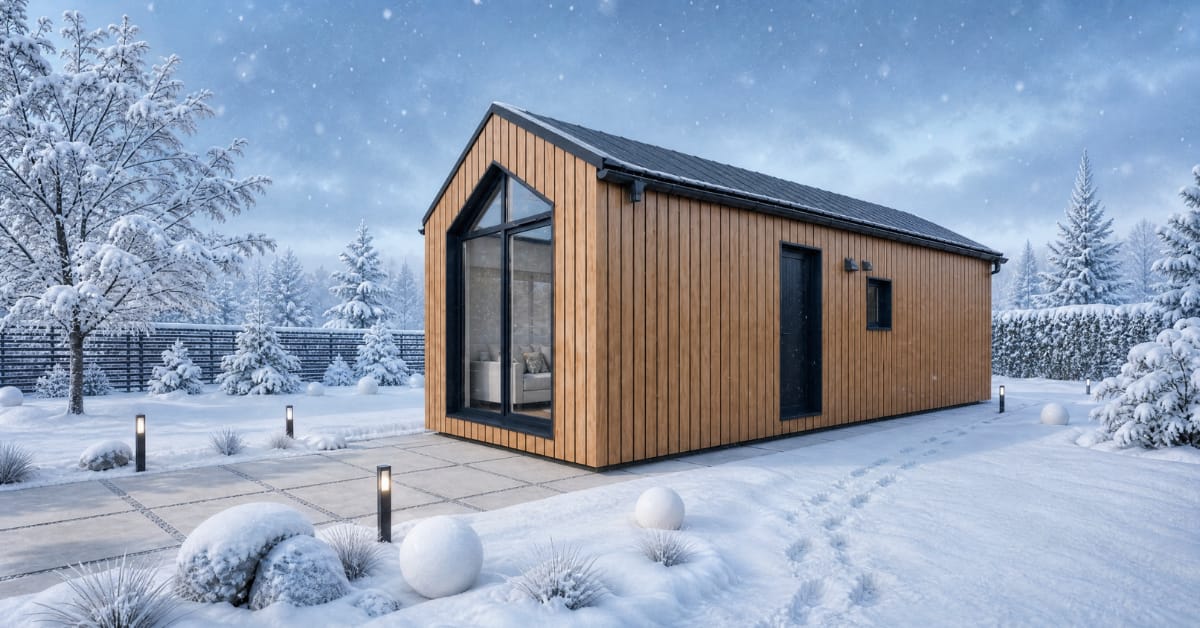
hort answer is – yes, modern modular homes are exceptionally warm during British winters, consistently outperforming many traditional brick builds, but the why and how of how this result is achieved is fascinating on its own. How is it possible that a construction that started as humble post-war prefab shacks has now evolved into modern luxury homes that outperform traditional houses on almost every level?
The Evolution of Modular Buildings in the UK
For decades, British homebuyers associated off-site construction with draughty post-war prefabs. Today, the reality of modular buildings in the UK is vastly different. Modern volumetric construction creates permanent, highly durable residences designed specifically to handle the relentless damp and biting winds characteristic of the British climate.
The secret lies in the thermal envelope. Traditional site-built homes are exposed to rain and moisture during construction, which can compromise the structural timber and insulation materials. In contrast, factory-built modules remain completely dry throughout the entire manufacturing process. This pristine environment allows builders to fit insulation perfectly, eliminating the micro-gaps and thermal bridges that cause cold spots in standard brick-and-block houses.
Decoding Modular House Insulation
When examining modular house insulation, the metrics speak for themselves. The UK government mandates strict thermal performance standards through Building Regulations Part L, but reputable manufacturers often treat these targets as a baseline rather than a ceiling.
- Insulated panels: Instead of hollow timber frames stuffed with rolled fibreglass, many modular homes use SIPs or PIR. These panels feature a dense core of rigid polyurethane foam sandwiched between engineered timber, providing a continuous thermal seal.
- Precision Engineering: Because the components are cut by computer-guided lasers and saws, there are virtually no gaps left around window frames, doors, or corners.
- Vapour Barriers: Advanced membranes are integrated into the walls to prevent moisture from entering the property while simultaneously reflecting heat back into the living space.
The result is that the warmth generated inside your property stays exactly where you want it.
Even Modular Containers Offer Winter Warmth
A common misconception is that steel-framed structures cannot retain heat. However, modern modular containers repurposed for residential living undergo extreme thermal retrofitting before they ever reach a site.
Builders do not simply line the metal walls with thin padding. Instead, they construct an entirely independent, highly insulated internal stud frame. This process creates a thick cavity that is densely packed with closed-cell spray foam or high-grade mineral wool. This method effectively decouples the interior living space from the exterior metal shell. Consequently, the freezing external temperatures never transfer to the inner walls, ensuring occupants remain incredibly comfortable even during severe snowstorms.
Understanding the Science of Airtightness
Proper home insulation is only half the battle against British winters; airtightness constitutes the remaining half. You can pack a loft with thick fibreglass, but if the property suffers from draughts, the warm air simply escapes into the atmosphere.
Modular construction excels at creating airtight environments. Because the modules are constructed using computer-aided design and automated cutting tools, the joints between the walls, floors, and ceilings are exact. There is zero tolerance for the shifting or settling that creates cracks in conventional mortar over time.
To ensure indoor air quality remains high and moisture does not build up in such tightly sealed spaces, these modern homes frequently integrate Mechanical Ventilation with Heat Recovery (MVHR) systems. These sophisticated units extract stale air from bathrooms and kitchens, pass it through a high-efficiency heat exchanger, and use that captured warmth to heat fresh incoming air from the outside.
Financial and Environmental Benefits
The superior thermal efficiency of modular living translates directly into substantial financial savings. With energy prices across the United Kingdom remaining volatile, securing an A-rated Energy Performance Certificate (EPC) is a top priority for developers and homeowners alike.
Modular properties require significantly less energy to heat up and, crucially, they retain that heat for much longer after the central heating switches off. This cycle means your boiler or heat pump works far less strenuously. Ultimately, this reduces your overall carbon footprint while protecting your household budget from sudden winter price spikes.
Making the Smart Move This Winter
Dismissing off-site construction based on outdated stereotypes is a mistake. The advanced engineering and premium materials used in today’s modular structures guarantee a cosy, draught-free winter sanctuary. Whether you are developing a large commercial plot or building a bespoke personal residence, modular construction offers the definitive solution for staying exceptionally warm while keeping energy consumption remarkably low.