For a small or mid-sized water utility, the metering conversation often feels like a choice between standing still and taking an expensive leap. Vendors promote full advanced metering infrastructure (AMI) with fixed networks and real-time data. Yet thousands of utilities still read meters by walking up to them, and thousands more use automated meter reading (AMR), where a meter reader drives or walks past and collects readings by radio.
Is AMR still a sensible investment in an AMI world? For many utilities the answer is yes, as long as the decision is made with clear eyes. This article explains how AMR works, where it still delivers strong value, and how to avoid locking yourself out of a future upgrade.
How AMR Works
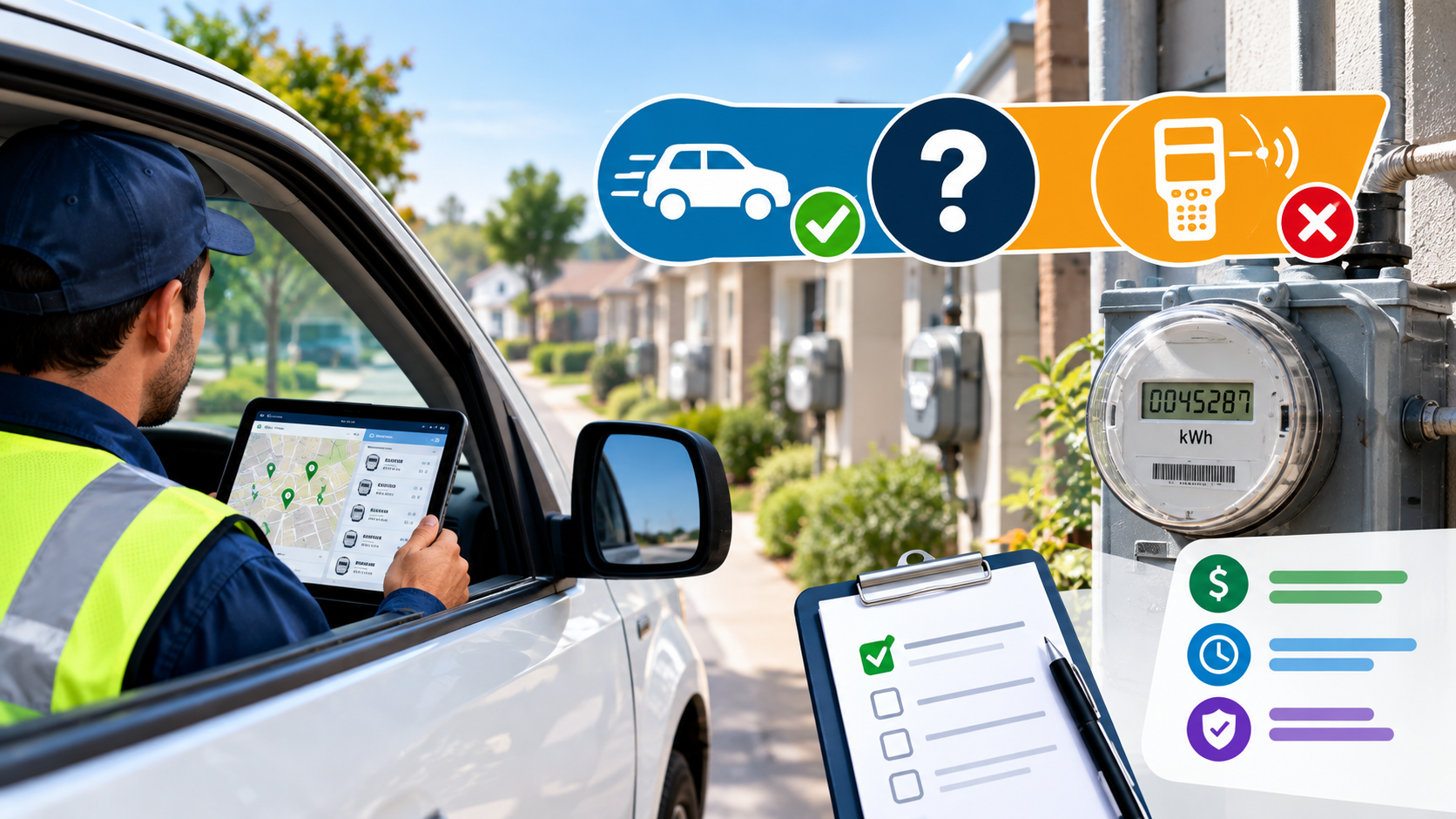
An AMR system adds a radio endpoint to each meter. The endpoint reads the meter register electronically and broadcasts the reading, typically on a one-way radio signal. A reader carrying a handheld receiver, or driving a vehicle fitted with a receiver and laptop, collects the readings as they pass. Back at the office, the readings are uploaded to the billing system.
Compared with manual reading, AMR removes the need to open meter pits, find the register and write down numbers. A drive-by route that took several days on foot can often be completed in hours.
AMR vs Manual Reading vs AMI
| Feature | Manual Reading | AMR (Walk-By or Drive-By) | AMI (Fixed Network) |
|---|---|---|---|
| Data collection | Person reads each meter | Radio collection from a passing reader | Automatic transmission to a network |
| Read frequency | Monthly or less | Usually monthly, on the billing cycle | Hourly or more often |
| Communication | None | Mostly one-way | Two-way |
| Reading errors | Common transcription errors | Very low | Very low |
| Leak and tamper alerts | Only if noticed | Flags at time of collection | Near real-time alerts |
| Customer usage portal | No | Limited | Yes, with interval data |
| Upfront cost | Lowest | Moderate | Highest |
| Ongoing labor | Highest | Low | Lowest |
| Network infrastructure | None | None beyond vehicles and receivers | Collectors, towers or cellular contracts |
Where AMR Still Makes Strong Sense
Small and rural utilities. In service areas with a few thousand connections spread over a large area, building a fixed network can be expensive per meter. A single vehicle with a receiver can cover the entire system efficiently.
Tight capital budgets. AMR endpoints cost less than most AMI endpoints and require no towers, collectors or backhaul contracts. The labor savings over manual reading are immediate and easy to quantify.
Safety and access problems. Meters in traffic, behind locked gates or guarded by dogs are hazardous to read by hand. AMR lets readers stay in the vehicle.
Accuracy and billing disputes. Eliminating manual transcription errors alone can reduce customer complaints and re-reads significantly.
What AMR Cannot Do Well
AMR’s limits come from the fact that data arrives only when a reader passes by. That means:
- Continuous leaks on the customer side may run for weeks before the next read reveals them.
- There is no easy way to offer customers daily or hourly usage data.
- District-level water balance and non-revenue water analysis are harder without synchronized interval data.
- Remote functions such as valve shut-off are generally not available.
Many modern AMR endpoints do store interval data internally and flag leaks, backflow and tampering, which the reader downloads during collection. This narrows the gap with AMI, but it does not close it.
Protecting Your Upgrade Path
The biggest risk with AMR is buying a dead end. Several vendors now offer endpoints that work in drive-by mode today and can join a fixed network later, sometimes with a firmware change or by adding collectors. This hybrid approach lets a utility start with AMR economics and migrate to AMI area by area as budget allows.
When evaluating systems, ask whether endpoints are network-ready, how long the batteries last (water endpoints are often rated for 15 to 20 years), whether the radio protocol is proprietary, and how the head-end software integrates with your billing and customer information system. Utilities weighing these options can compare proven automated meter reading (AMR) solutions, including those supplied and installed by MAYA Global Group, against their current reading costs and future plans.
Building the Business Case
- Current reading cost: staff hours, vehicles, re-reads and estimated bills.
- Revenue recovery: old mechanical meters tend to under-register as they age. Replacing meters along with the AMR rollout often recovers lost revenue.
- Customer service savings: fewer disputes and fewer high-bill complaints.
- Future-proofing value: the cost avoided if endpoints can later migrate to AMI.
Frequently Asked Questions
What is the main difference between AMR and AMI?
AMR collects readings when a reader passes by, usually over one-way radio. AMI sends data automatically over a fixed two-way network, often many times per day.
How long do AMR endpoints last?
Water meter endpoints are commonly designed for battery lives of 15 to 20 years, depending on how often they transmit.
Can AMR detect leaks?
Many AMR endpoints flag continuous flow that suggests a leak, but the utility only sees the flag when the reading is collected.
Conclusion
AMR is not the newest technology, but for many utilities it remains a smart, affordable improvement over manual reading. The key is to choose endpoints and software that keep the door open to AMI, so today’s savings become the foundation for tomorrow’s smarter network rather than a system that has to be torn out.