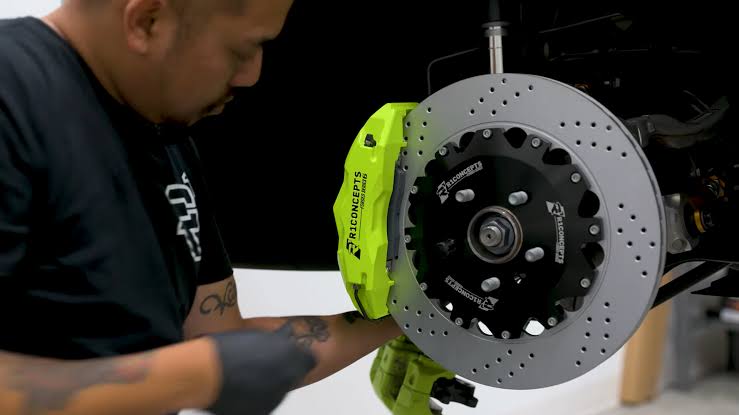
For most of motoring history, the brake caliper was a part only mechanics paid attention to. It sat hidden behind small steel wheels and plastic trims, finished in plain grey or black. Larger, more open alloy wheel designs have changed that. On many modern cars, the caliper is now clearly visible through the spokes, and its colour has become part of how a car looks.
Brake dust has also become a subject of regulation. The EU’s Euro 7 standard is the first vehicle emissions standard to set limits on particles from brakes, not only from exhausts, reflecting growing interest in what wears away from a car as it is driven. For owners, the more immediate concern is the dark residue that settles on calipers and wheels, and how well their finish copes with it.
Why owners paint calipers
The motivations are partly cosmetic. Coloured calipers, long associated with performance models from manufacturers that fit them as standard, give a car a sportier appearance and can complement or contrast with the wheel finish. Red, yellow and silver are common choices, though almost any colour is possible.
There is a practical side too. Bare cast iron calipers rust, particularly after a winter of salt and standing water, and a rusted caliper behind a freshly refurbished wheel can spoil the overall look. A suitable coating slows that corrosion and makes the caliper easier to clean.
What the job involves
Caliper paint has to cope with conditions that ordinary paint cannot. Brakes generate considerable heat, and calipers are regularly exposed to brake fluid, road salt, water and cleaning chemicals. Specialist high-temperature paints or coatings are used for this reason.
Preparation does most of the work. The caliper must be thoroughly cleaned and degreased, and rust removed. The brake discs, pads, rubber seals, bleed nipples and brake hoses must all be protected, since paint on a disc or pad would reduce braking performance. Some specialists paint calipers in place with the wheel removed and everything around them masked. Others remove the calipers from the car, which allows a more thorough finish but means the brakes must be reassembled and checked afterwards.
Because brakes are a safety-critical system, many owners prefer to leave the work to a garage or wheel specialist rather than attempt it at home.
Timing it right
The most efficient time to paint calipers is when the wheels are already off the car, such as during a brake service or a wheel refurbishment. That avoids paying twice for labour that overlaps.
Some wheel refurbishers offer caliper painting alongside their core work for this reason. Alloy Fix, which refurbishes and repairs alloy wheels at workshops in Romford, Dartford and Hemel Hempstead, lists caliper painting among its services alongside powder coating and diamond cutting.
Keeping the finish
A painted caliper needs little special care, but regular washing during winter stops brake dust and salt from building up. Strong acidic wheel cleaners can dull some finishes, so a gentler product is usually recommended. Chips from stones are best touched in early to stop rust starting underneath.
There are no legal restrictions on caliper colour in the UK, and the MOT test does not consider it. What matters to an examiner is that the brakes work, which is a useful reminder that the cosmetic job should never come at the expense of the mechanical one.