Workplace accidents come in all shapes and sizes and occur in every sector, in hazardous environments like construction sites and relatively safe ones like offices. If they can be proved to be the fault of the business, employees could pursue workplace accident claims for fair financial compensation.
This is because employers are legally required to protect employees and the public when they’re on-site, as part of the Health and Safety at Work etc. Act 1974. Negligence, poor training and improper work conditions can all be cited as reasons for avoidable accidents, so doing your due diligence is important to protect your staff and your business.
- Conduct thorough risk assessments
You cannot safeguard against dangers until they’ve been identified. Start by conducting assessments of your sites, ensuring these encapsulate all potential hazards from equipment and substances to the way people work and the general environment. You should then consider the risk level of each hazard and make adjustments where necessary to minimise the chance of harm.
Different types of risk assessments include:
- Fire – to establish a mandatory fire safety management procedure.
- Manual handling – if employees are required to move or carry loads.
- Display screen equipment (DSE) – such as computers or laptops.
- COSHH – where hazardous substances are used, manufactured or stored.
- Provide adequate training
All employees should receive sufficient training in health and safety for their specific duties and the wider business environment. This should go beyond a basic introductory session, so follow up with regular training throughout their employment. Even if nothing has changed, refreshing their memory goes a long way towards preventing accidents.
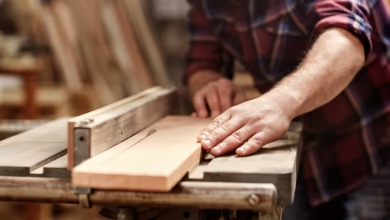
This is especially important in industries where staff are required to use tools and heavy-duty machinery, which can easily cause injury if mishandled. It’s not a coincidence that the construction sector records the most fatalities each year, closely followed by agriculture, forestry and fishing.
- Invest in protective measures
Supplementing training with practical protective measures is key to mitigating accidents. For manual jobs, this could include a range of Personal Protective Equipment (PPE) such as hard hats to protect against falling objects, safety glasses and gloves, steel-toe boots and hi-vis vests. In an office space, consider ergonomics and ensure each desk is equipped with a chair providing proper lumbar support.
As well as providing physical equipment, you could also invest in signage to remind employees of key risks and their responsibilities in minimising the chance of injury. For example, display lifting guides in storerooms and place user manuals near machinery.
- Perform regular safety inspections
Even with all this in place, don’t be complacent and allow standards to slip. Human error from tiredness, laziness or ignorance is a major factor in most workplace accidents, compounding to create an unsafe environment.
Appoint key people within your team to be safety supervisors and schedule regular inspections to help keep staff on the ball with crucial safety measures. If you find common issues recurring, try incentivising good behaviour to crack down on problems while helping boost staff morale.