How to Calculate Business Rates: Complete UK Guide for 2026
Last Updated: June 19, 2026

Business rates are an important operating cost for companies using shops, offices, warehouses, factories, pubs, hotels, and other non-domestic properties.
Knowing how to calculate business rates helps you estimate property expenses, prepare an accurate budget, check your council bill, and identify relief that could reduce the amount payable.
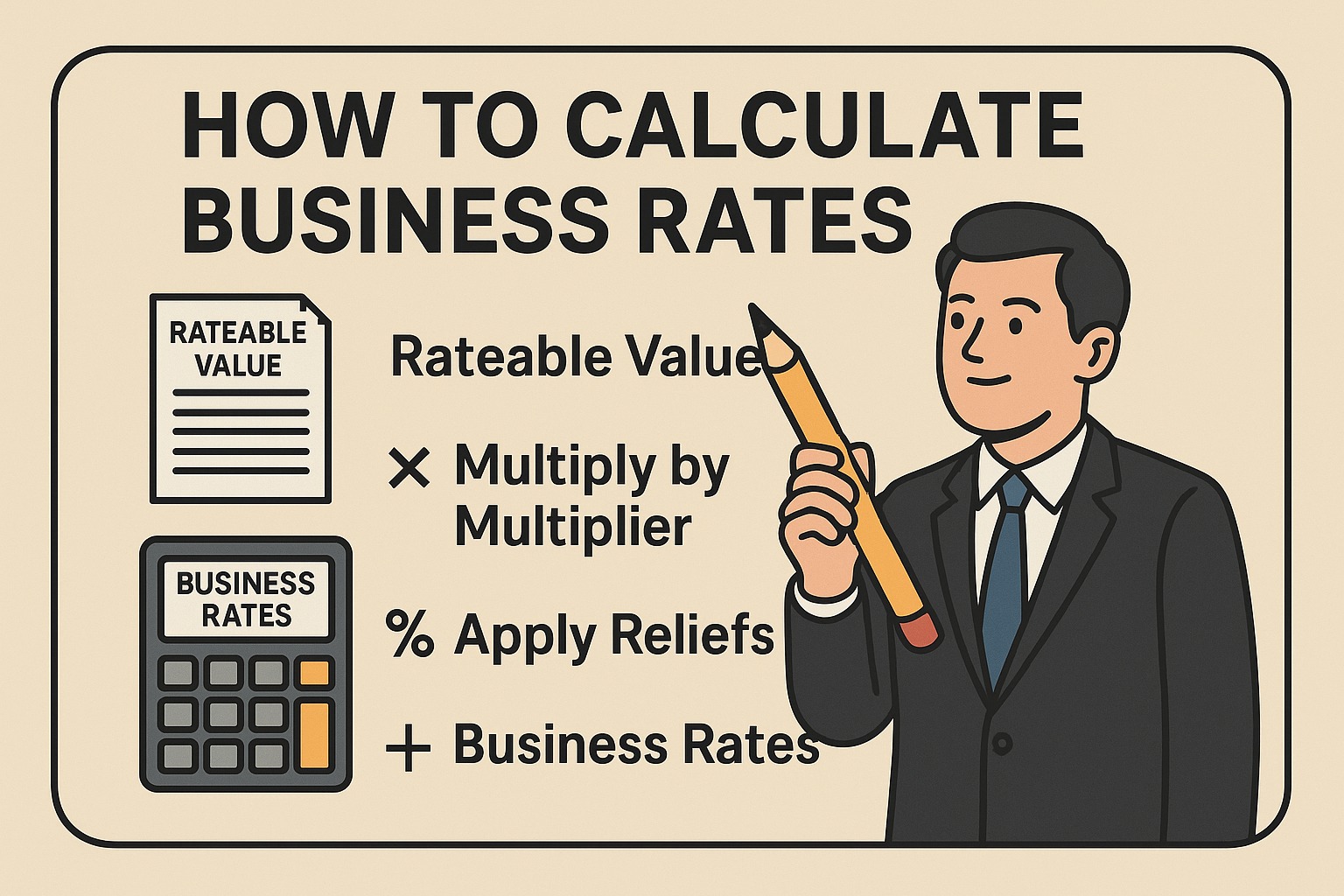
The basic calculation is simple:
Rateable Value × Business Rates Multiplier = Basic Annual Bill
Any business rates relief, transitional adjustment, local supplement, or discount is applied after this basic figure has been calculated.
Quick Business Rates Summary
| Detail | Current Information |
|---|---|
| Tax year covered | 1 April 2026 to 31 March 2027 |
| Basic calculation | Rateable value × multiplier |
| Small business multiplier | 43.2p |
| Standard multiplier | 48p |
| Small retail, hospitality and leisure multiplier | 38.2p |
| Standard retail, hospitality and leisure multiplier | 43p |
| High-value multiplier | 50.8p |
| High-value property threshold | £500,000 or more |
| Full small business relief threshold | £12,000 or less |
| Partial small business relief range | £12,001 to £15,000 |
| Current revaluation date | 1 April 2026 |
| Valuation reference date | 1 April 2024 |
These national multiplier figures apply to properties in England outside the City of London. Different rules and multipliers apply in Wales, Scotland, Northern Ireland, and the City of London.
What Are Business Rates?
Business rates, also called non-domestic rates, are a property-based tax charged on most buildings used for commercial or professional purposes.
They help local authorities fund public services within their areas. The bill is normally issued and collected by the local council responsible for the property.
Business rates may apply whether you own the premises or rent them. Responsibility normally falls on the person or organisation occupying the property.
Businesses should include rates when calculating occupancy costs, rent commitments, utilities, insurance, maintenance, and other commercial property expenses.
A commercial property consultant may also help businesses understand property costs before signing a lease or making a long-term investment.
What Is Rateable Value?
Rateable value is an estimate of the annual rent a non-domestic property could reasonably have achieved on the open market on a specified valuation date.
It is not the same as the rent you currently pay. It is also not the final amount of business rates charged by your council.
The Valuation Office sets the rateable value after considering factors such as the property’s size, location, use, layout, rental evidence, and local market conditions.
For the 2026 rating list, rateable values are based on estimated rental values from 1 April 2024.
The latest revaluation took effect on 1 April 2026, and the new rateable values are expected to remain in use until 31 March 2029, unless a property’s circumstances change.
You can find your current valuation through the official GOV.UK business rates calculator.
Official Video: What Is a Rateable Value?
Who Calculates Your Business Rates Bill?
The Valuation Office determines the rateable value of the property.
The UK government sets the national business rates multipliers for England each financial year.
Your local council then multiplies the property’s rateable value by the correct multiplier. It also applies any relief, transitional protection, local supplement, or exemption for which the property qualifies.
The council sends the final bill and manages payment arrangements.
Business Rates Multipliers for 2026/27
England moved from two main multipliers to five multiplier categories from 1 April 2026.
The multiplier used now depends on the property’s rateable value and whether it qualifies as a retail, hospitality, or leisure property.
| Property Type | Rateable Value | 2026/27 Multiplier |
|---|---|---|
| Small non-RHL property | Below £51,000 | 43.2p |
| Standard non-RHL property | £51,000 to £499,999 | 48p |
| Small retail, hospitality or leisure property | Below £51,000 | 38.2p |
| Standard retail, hospitality or leisure property | £51,000 to £499,999 | 43p |
| High-value property | £500,000 or more | 50.8p |
Retail, hospitality and leisure properties may include qualifying shops, cafés, restaurants, pubs, hotels, cinemas, gyms, music venues, and similar premises.
Eligibility is determined by the local council. A business should not automatically apply the lower multiplier without checking its bill or contacting the relevant authority.
How to Calculate Business Rates Step by Step
Step 1: Find the Rateable Value
Start by checking the rateable value shown on your council bill or the government’s business property valuation service.
Check that the listed property address, floor area, business use, and other details are correct.
Step 2: Identify the Correct Multiplier
Choose the multiplier based on the property’s rateable value and business category.
A standard office with a rateable value below £51,000 normally uses the 43.2p small business multiplier.
A qualifying café with the same rateable value may use the lower 38.2p retail, hospitality and leisure multiplier.
Step 3: Convert Pence Into a Decimal
The multiplier must be converted into pounds before completing the calculation.
For example:
- 38.2p becomes 0.382
- 43p becomes 0.43
- 43.2p becomes 0.432
- 48p becomes 0.48
- 50.8p becomes 0.508
Step 4: Multiply the Rateable Value
Multiply the rateable value by the applicable decimal multiplier.
This produces the basic annual liability before relief, transitional adjustments, or local supplements are applied.
Step 5: Deduct Eligible Relief
Check whether the business qualifies for small business rate relief, charitable relief, rural relief, empty property relief, transitional relief, or another scheme.
The final council bill may therefore be lower than the initial calculation.
Business Rates Calculation Example
Consider a professional office in England with a rateable value of £40,000.
Because its rateable value is below £51,000 and it is not a qualifying retail, hospitality or leisure property, the 43.2p multiplier applies.
£40,000 × 0.432 = £17,280
The estimated basic annual business rates bill is £17,280 before relief.
The estimated monthly cost would be:
£17,280 ÷ 12 = £1,440 per month
The council may normally issue payments over ten monthly instalments, although eligible ratepayers can request twelve monthly instalments.
Retail, Hospitality and Leisure Example
Imagine a qualifying restaurant with a rateable value of £110,000.
Its value is between £51,000 and £499,999, so the standard retail, hospitality and leisure multiplier of 43p applies.
£110,000 × 0.43 = £47,300
Its basic annual bill would therefore be £47,300 before any additional relief or adjustment.
Businesses preparing budgets should treat rates as part of their full operating cost rather than looking only at rent or business turnover.
High-Value Property Example
A large distribution centre has a rateable value of £600,000.
Properties with a rateable value of £500,000 or more use the high-value multiplier of 50.8p.
£600,000 × 0.508 = £304,800
The estimated basic annual bill is £304,800 before relief, supplements, or adjustments.
Small Business Rate Relief
Small Business Rate Relief can reduce or remove the bill for eligible businesses occupying smaller properties.
A business using only one property may receive 100% relief when its rateable value is £12,000 or less.
This means no business rates will normally be payable.
For properties with a rateable value between £12,001 and £15,000, relief gradually reduces from 100% to 0%.
For example, a qualifying property with a rateable value of £13,500 receives 50% relief.
Eligibility can become more complicated when a business occupies multiple properties. Businesses should review the official business rates relief guidance or contact their local council.
Business owners should consider rates, tax registration, legal structure, and premises costs when they register a business.
Other Types of Business Rates Relief
Charitable Rate Relief
Registered charities and community amateur sports clubs may receive 80% mandatory relief when a property is used mainly for charitable purposes.
The local council may choose to reduce some or all of the remaining bill.
Rural Rate Relief
Certain businesses in qualifying rural settlements may receive relief.
This can apply to essential local services such as the only village shop, post office, petrol station, or public house, subject to property value and population conditions.
Empty Property Relief
Most empty commercial properties receive an initial three-month exemption from business rates.
Certain qualifying industrial properties, including some warehouses and factories, may receive a six-month exemption.
Rates usually become payable after the exemption period unless another exemption applies.
Transitional Relief
Revaluation can cause a property’s bill to rise sharply.
Transitional relief limits how quickly certain bills increase after a revaluation. It is normally applied automatically by the council.
Supporting Small Business Relief
This relief may protect businesses that lost some or all of their previous small business or retail-related support following the 2026 revaluation.
The amount depends on the business’s previous bill, current rateable value, and applicable limits.
Improvement Relief
Qualifying property improvements may receive temporary relief from the increase in business rates caused by those improvements.
The business must continue occupying the property and satisfy the scheme conditions.
Hardship Relief
Local councils may reduce a bill where a business is experiencing serious financial hardship and granting relief would benefit the local community.
This relief is discretionary, so approval is not guaranteed.
How Revaluation 2026 Affects Businesses
The 2026 revaluation updated the rateable values of more than two million non-domestic properties.
The purpose is to reflect changes in the commercial rental market since the previous valuation period.
A higher rateable value does not always create the same percentage increase in the final bill. New multipliers, transitional relief, and other schemes can change the result.
Similarly, a lower rateable value may not produce an identical reduction if other adjustments apply.
Businesses should compare the new valuation, multiplier, relief, and final council calculation rather than focusing on one figure alone.
Regular financial planning is one of the five Ps of entrepreneurship because property liabilities can directly affect cash flow and profit.
What to Do If Your Rateable Value Is Wrong
Check the official property record before challenging the valuation.
Look for errors involving the property’s address, floor area, building type, use, layout, or other physical details.
You can use a business rates valuation account to report incorrect property information and challenge the valuation.
Provide clear evidence, such as lease details, floor plans, rental comparisons, photographs, or information about physical changes.
Continue paying the existing council bill while the challenge is being considered. Filing a challenge does not normally suspend payment obligations.
Be cautious with unverified agents promising guaranteed reductions. Check their experience, fees, professional background, and authority before sharing business information.
Business Rates for Home-Based Companies
A person working from home does not normally pay business rates when the room remains mainly part of the home.
Business rates may apply when part of the property is used exclusively for commercial activity, has been physically adapted, serves visiting customers, or employs staff working from the premises.
The exact position depends on how the property is used and whether the Valuation Office creates a separate non-domestic assessment.
Business Rates Across the UK
The calculations in this guide mainly cover England.
Wales uses its own national multiplier and relief arrangements.
Scotland uses non-domestic rates with Scottish poundage figures and separate relief schemes.
Northern Ireland calculates business rates using regional and district rates.
The City of London can also apply different multiplier arrangements from the rest of England.
Businesses operating in several regions should calculate each property separately under the rules applying to its location.
How to Manage Business Rates Properly
Keep copies of council bills, valuation records, relief applications, property leases, and payment confirmations.
Check every new bill against the property’s current rateable value and multiplier.
Include rates in monthly cash-flow forecasts rather than treating them as an unexpected annual expense.
Accounting software and other business computing tools can help track instalments, property costs, tax deadlines, and financial records.
Contact the council quickly if the property becomes empty, the business moves, the building is extended, its use changes, or another property is acquired.
Delays can result in incorrect bills, backdated charges, or missed relief.
Common Business Rates Mistakes
One common mistake is multiplying the current rent by the multiplier instead of using the official rateable value.
Another is using an old 2025/26 multiplier when estimating a 2026/27 bill.
Some businesses assume the small business multiplier automatically means they receive Small Business Rate Relief. These are separate parts of the system.
Others forget to check whether the property qualifies for a retail, hospitality and leisure multiplier.
Businesses can also overpay when they fail to report incorrect property details or apply for available relief.
Frequently Asked Questions
How are business rates calculated?
Multiply the property’s rateable value by the correct annual multiplier, then deduct any relief or adjustment.
What is the small business multiplier for 2026/27?
The small business multiplier in England is 43.2p for eligible non-RHL properties with a rateable value below £51,000.
What is the standard multiplier for 2026/27?
The standard multiplier is 48p for non-RHL properties valued from £51,000 to £499,999.
What is the high-value multiplier?
Properties with a rateable value of £500,000 or more use the 50.8p high-value multiplier.
Do businesses with a rateable value below £12,000 pay rates?
An eligible business using only one property may receive 100% Small Business Rate Relief and pay no business rates.
Is rateable value the same as rent?
No. Rateable value is an official estimate of annual rental value on a set valuation date.
Can I challenge my rateable value?
Yes. You can check the property information and submit a challenge when you have evidence that the valuation is incorrect.
Are business rates paid monthly?
Councils normally offer instalments. Bills commonly use ten monthly payments, but businesses may request twelve monthly instalments.
Final Thoughts
Learning how to calculate business rates gives business owners greater control over property costs and financial planning.
Start with the correct 2026 rateable value, choose the applicable multiplier, calculate the basic liability, and then subtract any relief.
Always check the final council bill because eligibility, transitional arrangements, local supplements, and individual property circumstances can affect the amount payable.