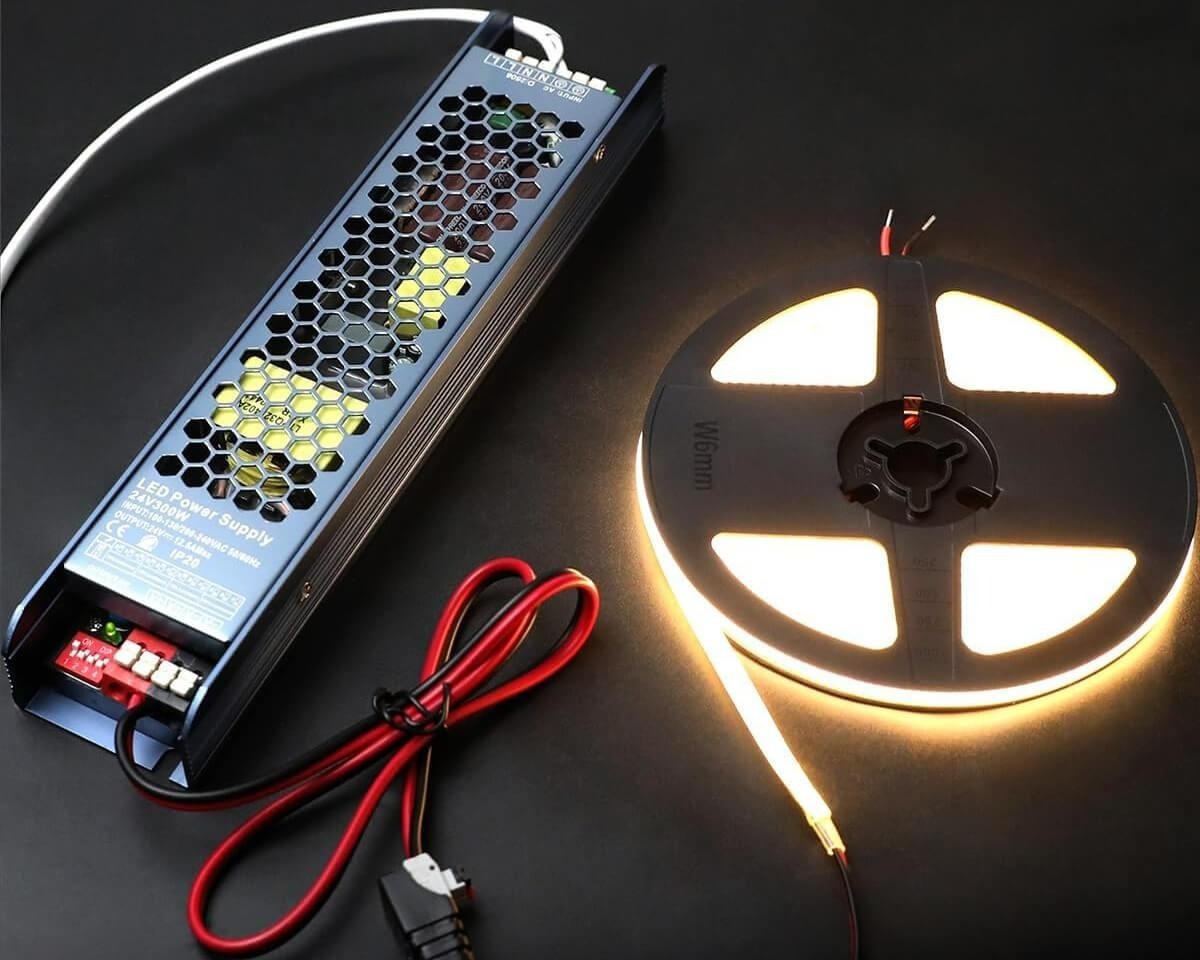
As LED strip lighting continues to evolve, the underlying electrical architecture supporting it has become increasingly sophisticated. What once seemed like a basic “plug-and-play” lighting accessory is now a true engineered subsystem requiring careful attention to voltage selection, current capacity, load balancing, voltage drop management, thermal performance, surge protection, wiring topology, and driver compatibility.
In modern installations—whether residential, commercial, or industrial—these factors determine not only the functional performance of the lighting system but also safety, long-term reliability, photometric consistency, maintenance requirements, and overall user experience.
For lighting designers, electrical engineers, and system integrators, understanding the interaction between LED light strips and power supply is no longer optional. The relationship between these components forms the foundation of every stable and scalable linear lighting system. This guide provides a comprehensive technical overview of power requirements, system matching, wiring strategies, and failure-prevention methods to help professionals design robust installations in 2026 and beyond.
Electrical Fundamentals Behind LED Strip Systems
Constant Voltage (CV) vs. Constant Current (CC)
Most LED strips operate on constant-voltage (CV) power—typically 12V or 24V DC—where the LED strip’s internal resistors or ICs regulate current. These are the familiar types found in architectural coves, cabinets, and general ambient lighting.
However, constant-current (CC) strips or modules operate differently. They require a current-regulated driver (e.g., 350 mA, 700 mA) and offer superior uniformity over long runs with lower voltage drop sensitivity.
| Type | Use Case | Benefit | Risk if mismatched |
|---|---|---|---|
| CV 12V / 24V | Standard LED strips | Simple wiring, widely available | Voltage drop in long runs |
| CC 350mA / 700mA | COB modules, linear LEDs | High uniformity, stable current | Immediate burnout if wrong driver is used |
Mismatching a constant-current driver with constant-voltage strips often leads to catastrophic LED failure because the current is not limited by the LED strip design.
Voltage Selection: Engineering Considerations
Choosing the correct working voltage for a project is crucial. Voltage determines wire length capacity, system current, voltage drop behavior, and overall installation cost.
12V Systems
Higher current demands
Shorter maximum run lengths (typically <5m)
More sensitive to voltage drop
Best for small installations or furniture integration
12V systems are ideal for compact applications but rarely recommended for modern architectural or commercial projects due to current load and efficiency limitations.
24V Systems
The current industry standard for professional linear lighting.
Benefits:
- Lower current at the same wattage
- Better dimming performance
- Longer runs per feed (10–15m depending on wattage)
- Less thermal stress
- Compatible with most architectural drivers and dimmers
24V is recognized as the best all-around choice for residential, hospitality, retail, and commercial installations.
48V Systems (2026 Trend)
48V LED strip systems are rapidly gaining popularity in commercial environments due to:
- 50% lower current compared with 24V systems
- Support for extremely long runs (>20m continuous)
- Improved energy efficiency
- Reduced copper wire cost
- Excellent voltage stability
- Compatibility with centralized power supply rooms
48V is becoming the preferred solution for airports, shopping malls, stadiums, and long-run façade lighting.
Wattage Engineering: Accurate Load Calculation
Engineering a safe LED strip system requires precise wattage calculations.
Formula:
Total Load (W) = Strip Wattage per Meter × Total Meters
Required PSU Wattage = Total Load × 1.25–1.35
This safety margin accounts for:
- Power supply efficiency loss
- Thermal headroom
- Start-up inrush current
- Long-term degradation
Load Examples:
| Strip Type | Length | Power | Minimum PSU |
|---|---|---|---|
| 14W/m RGBW | 10m | 140W | 180W |
| 10W/m Tunable White | 15m | 150W | 200W |
| 18W/m High-CRI White | 12m | 216W | 300W |
Running a PSU at more than 80% capacity increases heat, reduces driver lifespan, and compromises dimming stability.
Engineering Voltage Drop Analysis
LED systems are particularly sensitive to voltage drop because even small losses translate into visible performance differences. Voltage drop occurs due to the electrical resistance of wires, connections, and the LED strip’s internal PCB.
Formula:
Voltage Drop (V) = Current (A) × Cable Resistance (Ω)
Voltage Drop Impact Thresholds
- <3% — Excellent
- 3–5% — Acceptable
- 5–8% — Visible dimming
- >10% — Unacceptable for professional installations
Engineering Solutions to Voltage Drop
- Power injection every 5m
- Switching from 12V → 24V or 48V
- Using thicker cables (AWG14–18)
- Parallel distribution feeds
- Avoiding daisy-chaining multiple strip lengths
Voltage drop is one of the most common causes of dim ends, uneven color, or flickering in LED strip installations.
Choosing the Right Power Supply: Professional Guidelines
Power supplies have evolved beyond simple AC-DC converters. Their quality fundamentally affects LED performance.
Types of Power Supplies in 2026
| Power Supply | Benefit | Application |
|---|---|---|
| Plug-in Adapter | Easy for beginners | DIY, short runs |
| Metal Enclosed PSU | High power & durability | Signage, commercial |
| Slim Linear Driver | Fits inside profiles | Furniture, cabinetry |
| Waterproof PSU (IP67/IP68) | Outdoor & wet areas | Landscape, pools |
| Dimmable Drivers | TRIAC, 0–10V, DALI | Smart homes, architecture |
Why Power Supply Quality Matters
High-quality power supplies deliver:
- Low ripple (<3%)
- Stable output under load
- Surge protection
- Thermal protection
- Longer MTBF
- Compatibility with low-end dimming
Using low-grade PSUs leads to flicker, reduced LED lifespan, and unexpected failures.
Safety Engineering & Compliance Requirements
Professional lighting systems must adhere to strict safety standards:
- Overload protection (OLP)
- Short-circuit protection (SCP)
- Over-temperature protection (OTP)
- Surge protection (especially outdoors)
- Certifications: UL8750, CE, RoHS, FCC, UKCA, SAA
Power supplies without these protections can pose serious safety risks, including overheating and electrical shock.
Wiring Topologies: The Professional Way
Single-End Feed Wiring
- Suitable for short lengths (<5m).
- Simple but highly sensitive to voltage drop.
Parallel Distribution Wiring
- The industry standard.
- Ensures balanced voltage across multiple sections.
- Reduces dimming inconsistencies.
Power Injection Method
Required for:
- COB strips
- High-density LED strips
- Long continuous runs
Injection points may be placed every 3–5m depending on load.
Amplifier-Based Wiring (RGB/RGBW/RGBIC)
Amplifiers ensure:
- Color consistency
- Signal integrity
- Stable operation over long distances
Essential for dynamic RGB systems where multiple LED segments must remain synchronized.
Thermal Management: The Overlooked Design Parameter
LED strips, particularly COB and high-density types, generate significant heat. Thermal buildup accelerates:
- Lumen depreciation
- Adhesive failure
- Color shift
- Driver stress
- PCB aging
Using Aluminum Profiles Provides:
- 30–50% longer lifespan
- Improved heat dissipation
- Stable CCT
- Mechanical protection
- Cleaner installation finish
Proper thermal design is essential for premium lighting applications.
Common Failure Modes & Engineering Solutions
| Failure Mode | Root Cause | Engineering Prevention |
|---|---|---|
| Flickering | Undersized PSU | Add 30% extra wattage |
| Yellowing | Overheating | Aluminum channels |
| Controller failure | Surge or unstable power | Surge protection |
| Dim ends | Voltage drop | Parallel wiring |
| Color mismatch | Uneven load | Amplifiers / injection |
Most failures are preventable when systems are engineered properly.
Recommended Deep-Dive Resource
For detailed wiring diagrams, parallel connection examples, voltage-drop avoidance techniques, and step-by-step system engineering, refer to this in-depth guide on LED light strips and power supply.
Conclusion
Matching LED light strips with the correct power supply is a foundational engineering task that directly influences system performance, safety, and long-term reliability. By understanding voltage behavior, calculating loads correctly, managing thermal conditions, selecting quality power supplies, and applying proper wiring strategies, lighting professionals can ensure consistent, stable, and efficient installations.
This expanded guide provides the depth required for 2026 lighting projects—whether you’re designing a smart home, commercial space, or industrial LED system.