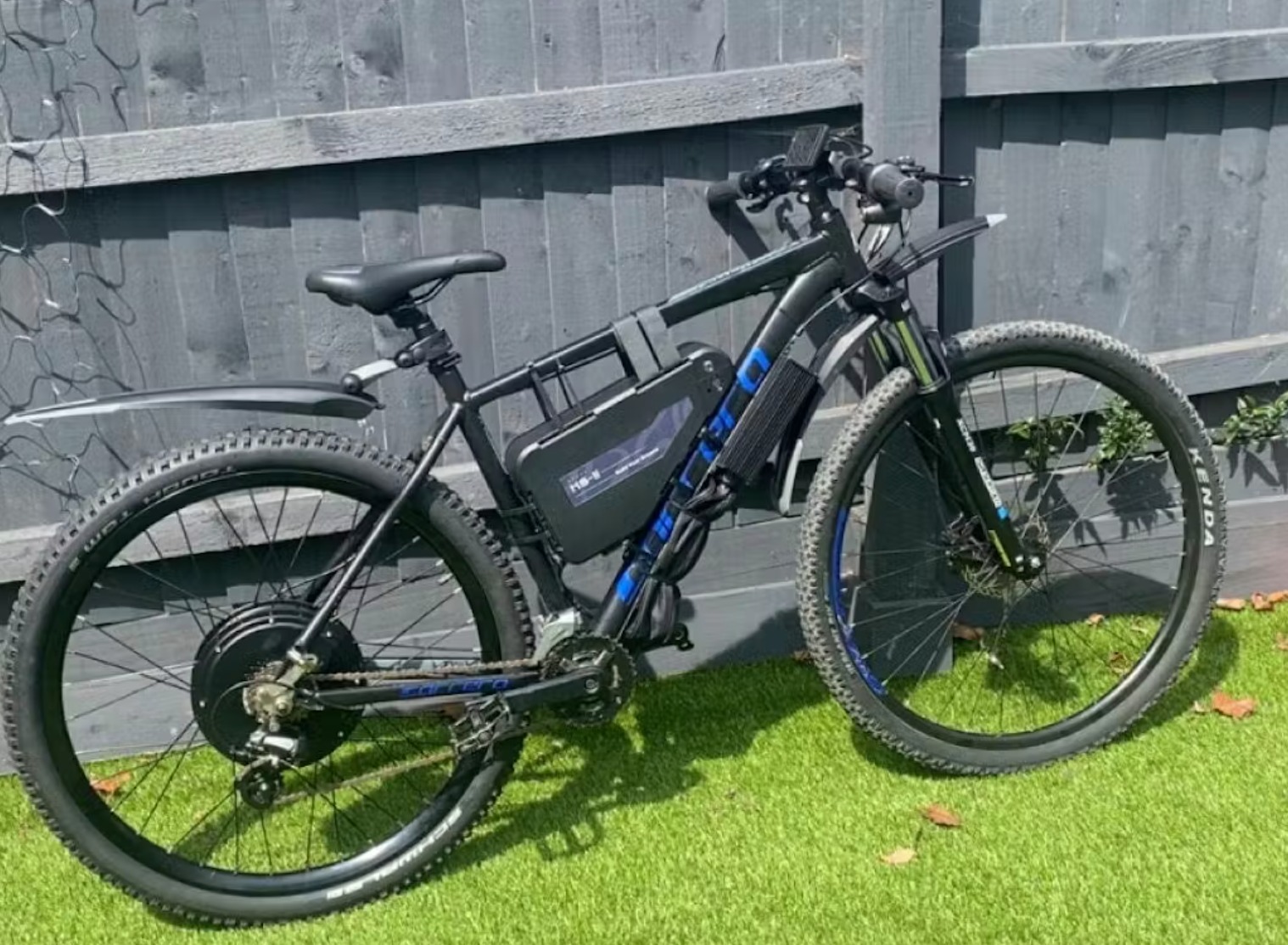
High-voltage electric bike conversion kits represent the pinnacle of e-bike performance, delivering motorcycle-level power with bicycle efficiency. The 72V platform has emerged as the ultimate choice for riders seeking extreme speed, exceptional hill-climbing capability, and uncompromising performance.
This comprehensive guide explores everything you need to know before investing in a 3000W-4000W 72V system, from technical specifications to legal considerations and real-world performance expectations.
Understanding 72V E-Bike Systems: The Performance Advantage
Voltage fundamentally determines an e-bike system’s power delivery potential and efficiency characteristics. While 36V and 48V systems dominate the entry-level and mid-range markets, 72V ebike kits with battery occupy the extreme performance category.
The Voltage-Power Relationship
Electric motor power follows a simple formula: Power (Watts) = Voltage × Current (Amps)A 4000W system can achieve this power through different voltage-amperage combinations:
48V system: Requires 83 amps (4000W ÷ 48V)
60V system: Requires 67 amps (4000W ÷ 60V)
72V system: Requires 56 amps (4000W ÷ 72V)
Higher voltage delivers the same power with lower current, resulting in:
Less heat generation in wiring and components
Reduced energy loss during transmission
Lighter gauge wiring requirements
Improved efficiency (8-12% better than 48V equivalents)
Longer component lifespan due to reduced thermal stress
Why 72V for 3000W-4000W Applications?
While technically possible to run 3000W-4000W motors on lower voltages, 72V systems provide optimal performance for several reasons:
Thermal Management: Lower amperage generates less resistive heat in controllers, wiring, and motor windings. This thermal advantage allows sustained high-power output without overheating.
Efficiency: Higher voltage reduces copper losses in motor windings and wiring. Real-world testing shows 72V systems deliver 8-15% better efficiency than 48V systems at equivalent power levels.
Component Longevity: Reduced thermal and electrical stress extends controller and motor lifespan significantly—often 50-100% longer than lower-voltage equivalents under similar usage patterns.
Performance Headroom: 72V systems maintain full power output even as battery charge depletes, whereas lower-voltage systems experience noticeable performance degradation below 60% charge.
Comparing Voltage Platforms
Specification
48V System
60V System
72V System
Optimal Motor Power
750W-1500W
1500W-2500W
2500W-5000W
Typical Top Speed
45-55 km/h
55-65 km/h
65-85 km/h
Hill Climbing
Good
Excellent
Outstanding
Efficiency Rating
Baseline
+6-8%
+10-15%
Heat Generation
High
Moderate
Low
Component Stress
High
Moderate
Low
System Weight
Light
Medium
Medium-Heavy
Power Levels Explained: 3000W vs. 4000W Performance
Within the 72V platform, motor power significantly impacts performance characteristics and practical applications.
3000W Systems: Balanced Performance
Speed Capabilities: 60-75 km/h (37-47 mph) on flat terrain with moderate pedaling Acceleration: 0-50 km/h in 4-6 seconds Hill Climbing: Handles 15-20% gradients at 25-30 km/h Range: 50-80 km depending on riding style and terrain Best For: Mixed terrain riding, daily performance commuting, recreational off-road
Three-thousand-watt systems deliver exceptional performance while maintaining reasonable battery consumption. They represent the sweet spot for riders wanting serious power without extreme battery drain or component stress.
The 60V 2500W-3000W MTX rim conversion kit demonstrates performance in this category, offering 75-85 km/h capability with professional-grade components designed for sustained high-power operation.
4000W Systems: Maximum Performance
Speed Capabilities: 70-85 km/h (43-53 mph) on flat terrain Acceleration: 0-50 km/h in 3-4 seconds Hill Climbing: Conquers 20-25%+ gradients at 30-35 km/h Range: 40-70 km depending on usage Best For: Extreme off-road, property maintenance, maximum performance applications
Four-thousand-watt systems deliver motorcycle-like performance with instant throttle response and seemingly unlimited torque. They excel in situations demanding maximum power: steep mountain trails, heavy cargo hauling, soft sand or snow, and high-speed cruising.
The 72V 4000W ebike kit with battery represents the pinnacle of hub motor conversion technology, combining 4000W peak output with 72V efficiency for sustained speeds exceeding 80 km/h.
Battery Systems for 72V Applications
Battery capacity and quality dramatically affect performance, range, and system reliability in high-power applications.
Understanding 72V Battery Configuration
A 72V nominal battery contains 20 lithium-ion cells in series (20S configuration):
Nominal Voltage: 72V (3.6V per cell × 20 cells)
Fully Charged: 84V (4.2V per cell × 20 cells)
Minimum Safe Voltage: 60V (3.0V per cell × 20 cells)
This 20S configuration provides the voltage foundation, while parallel cell groups (P) determine capacity.
Capacity Considerations
15Ah Batteries (20S3P – 60 cells total):
Capacity: 1,080 Wh (72V × 15Ah)
Range: 35-50 km with 3000W-4000W motors
Weight: 6-7 kg
Best For: Weight-conscious riders, shorter rides
20Ah Batteries (20S4P – 80 cells total):
Capacity: 1,440 Wh (72V × 20Ah)
Range: 50-70 km with 3000W-4000W motors
Weight: 8-9 kg
Best For: Balanced range and weight, daily riding
25Ah Batteries (20S5P – 100 cells total):
Capacity: 1,800 Wh (72V × 25Ah)
Range: 60-85 km with 3000W-4000W motors
Weight: 9-11 kg
Best For: Maximum range, all-day adventures
Motor Technology: Hub Drive Dominance at High Power
While mid-drive motors dominate 250W-1000W applications, hub motors reign supreme in 3000W-4000W territory.
Why Hub Motors for Extreme Power?
Simplicity: Hub motors contain everything within the wheel hub—no complex integration with drivetrain, bottom bracket, or chain line.
Durability: Sealed hub motors resist water, mud, and debris better than exposed mid-drive units. Critical for off-road high-power applications.
Direct Power: Hub motors deliver power directly to the wheel without drivetrain losses. Mid-drive systems lose 5-10% efficiency through chain, cassette, and derailleur.
Component Protection: High-power mid-drives destroy chains, cassettes, and chainrings rapidly. Hub motors eliminate this drivetrain stress entirely.
Cost: Hub motors cost significantly less than equivalent mid-drive systems while delivering comparable or superior performance in high-power applications.
Additional weight provides flywheel effect, smoothing power delivery
Installation Process: What to Expect
Installing 72V 3000W-4000W systems requires mechanical competence and careful attention to detail.
Pre-Installation Assessment
Frame Inspection:
Check for cracks, especially near welds
Verify dropout integrity
Measure dropout spacing
Confirm adequate tire clearance
Assess battery mounting locations
Component Evaluation:
Brake adequacy (upgrade if questionable)
Wheel strength (standard wheels insufficient for extreme power)
Fork strength (particularly for front motor installations)
Installation Steps Overview
Motor Wheel Installation (20-30 minutes):
Remove existing wheel
Install motor wheel in dropouts
Attach and secure torque arms
Tighten axle nuts to specified torque (50-60 Nm typical)
Install disc brake rotor (if not pre-installed)
Adjust brake caliper alignment
Connect motor cable
Controller Mounting (15 minutes):
Select mounting location with good airflow
Secure controller to frame or in ventilated bag
Ensure weatherproofing without blocking ventilation
Battery Installation (10-15 minutes):
Mount battery bracket to frame
Secure battery in bracket
Verify locking mechanism function
Connect battery to controller
Display and Controls (15 minutes):
Mount display on handlebars
Install throttle (twist or thumb style)
Connect brake sensors to brake levers
Install pedal-assist sensor (if using PAS)
Route all cables neatly away from moving parts
Wiring Connections (15-20 minutes):
Connect motor to controller (thick power cable)
Connect battery to controller (main power)
Connect display to controller (communication cable)
Connect throttle to controller
Connect brake sensors to controller
Connect PAS to controller
Double-check all connections for security
System Testing (20-30 minutes):
Power on display
Verify battery level reading
Test throttle response with wheel elevated
Test brake cutoff function (motor stops immediately)
Test PAS function (if equipped)
Short test ride in safe area
Check all fasteners for tightness
Re-test brakes under load
Total Installation Time: 2-3 hours for first installation, 1-1.5 hours with experience.
Common Installation Challenges
Motor Axle Fit: Some frames have slightly narrow or wide dropouts. Use washers or file dropouts carefully (steel frames only) for proper fit.
Battery Positioning: Large 72V batteries require significant space. Triangle bags fit most mountain bike frames; consider rear rack batteries for small frames.
Cable Management: High-power systems have thick cables. Plan routing carefully to avoid interference with pedals, brakes, or steering.
Brake Sensor Adjustment: Sensors must trigger immediately when levers move. Test thoroughly—delayed cutoff creates dangerous situations.
Upgrading and Customization Options
Battery Capacity Upgrades
Increase range without changing other components:
72V 15Ah → 20Ah: +33% range
72V 20Ah → 25Ah: +25% range
72V 20Ah → 30Ah: +50% range
Higher capacity batteries require adequate frame space and add weight (approximately 1.5-2 kg per 5Ah increase).
Controller Programming
Advanced controllers allow parameter adjustment:
Maximum current (limit power for extended range)
Acceleration curves (soft vs. aggressive)
Regenerative braking strength (if supported)
Low-voltage cutoff (protect battery by adjusting when power cuts)
Programming typically requires computer connection via USB or specialized programming cables.
Display Upgrades
Replace basic displays with advanced units offering:
Color screens for better visibility
GPS integration
Smartphone connectivity (Bluetooth)
More detailed performance data
Customizable layouts
Verify display compatibility with your controller’s communication protocol before purchasing.
Performance Enhancements
Motor Upgrades: Moving from 3000W to 4000W requires:
New motor wheel
Controller upgrade (higher amperage)
Possibly battery upgrade (higher discharge rate)
Reinforced frame components
Suspension: Adding or upgrading suspension:
Front fork: 100-120mm travel recommended
Rear shock: Full suspension dramatically improves control at speed
Ensure frame designed for suspension (can’t add to rigid-only frames)
Braking Improvements:
Larger rotors (180mm → 203mm)
Four-piston calipers (from two-piston)
Braided brake lines
Metallic brake pads
Wheel and Tire Upgrades:
Stronger wheels (more spokes, heavier-duty rims)
Wider tires (2.5-3.0″ for stability)
Puncture-resistant tire liners
Tubeless conversion (reduces pinch flat risk)
Conclusion: Is a 72V 3000W-4000W System Right for You?
These extreme-performance systems suit specific riders and applications. Consider whether you genuinely need this power level.
You SHOULD Consider 72V 3000W-4000W If:
You own private land with diverse terrain requiring high performance
Your property features steep hills or challenging off-road conditions
You need to cover large distances quickly on private roads
You desire maximum possible e-bike performance
You have adequate mechanical knowledge for maintenance
You can invest in proper safety equipment
You understand and accept the legal limitations
You Should Consider Alternatives If:
Primary use will be public roads (illegal for this power)
Budget constrained (lower power offers better value)
Mechanical experience limited (simpler systems more forgiving)
Riding mostly flat terrain (3000W+ overkill)
Range more important than speed (lower power = longer range)
Final Recommendations
For riders with legitimate need for extreme power and private space to use it, 72V 3000W-4000W systems deliver unmatched performance. The combination of high voltage efficiency and substantial power creates an e-bike experience approaching motorcycle territory while maintaining bicycle simplicity and efficiency.
Choose 3000W for balanced performance with reasonable battery consumption. Select 4000W only if you need absolute maximum capability. Both provide thrilling performance far exceeding conventional e-bikes.
Backlinks Hub highly experienced SEO Team with over 4 years of experience. WE are working as contributors on 1000+ reputable blog sites. If You Need Guest Post and Our Seo Services Contact.