Avoid Costly Rework: How 5-Axis CNC Machining Solves Complex Geometry Challenges in Aerospace and Medical Manufacturing

Introduction
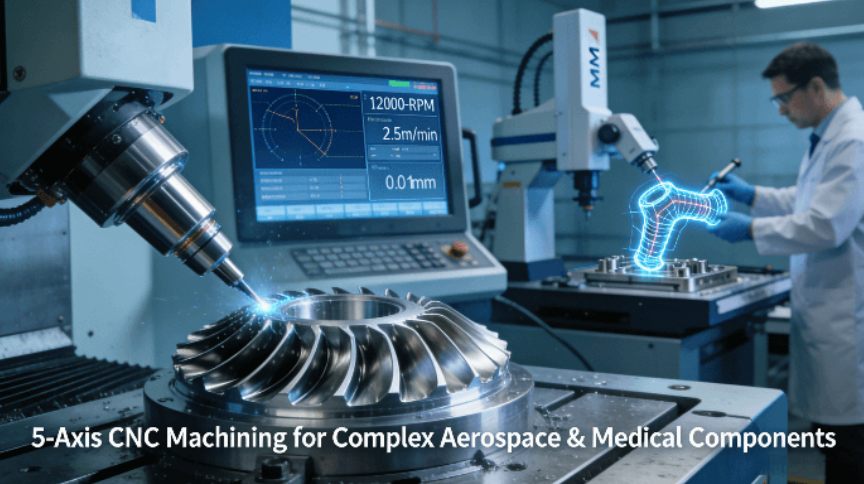
In the contemporary aerospace and biomed equipment sectors, designers are beset with the challenge of creating components such as turbine blades and implantable devices, whose geometry is increasingly complicated with free-form surfaces and deep holes for optimum performance. However, with 3-axis CNC machining, specialists encounter several problems, ranging from project delays to costly rework. The problem emanates from the nature of the technology, since multiple machining operations with cumulative errors are often involved, sometimes culminating in scrap rates that can go beyond the 30% threshold.
This article discusses how 5-axis CNC machining technology, with its stringent standards such as ASME Y14.5, offers the complete solution free from the drawbacks inherent in the traditional technology.
What are the limitations of traditional 3-axis machining in complex shapes?
Although sufficient for simpler components, the challenges presented by the complexity of modern components prove difficult for the capabilities offered by three-axis CNC machining.

Figure 2: Technical comparison demonstrating 70% reduction in positioning errors and 40% improvement in efficiency through 5-axis CNC’s single-setup capability versus traditional 3-axis multi-setup machining, highlighting elimination of cumulative errors in complex part manufacturing.
1. Cumulative Error of Multiple Setups
The major drawback of this technology is that it requires multiple part setups. Every time a part is moved to a different setup position, it introduces a new datum, and this brings about minute but crucial error values that keep adding up. As a result, it is possible that the finished part may lie beyond the accepted tolerance limits. It is not acceptable for parts that need to be accurate to micron levels.
2. Challenges from Limited Geometric Freedom
In the 3-axis system, the linear motion only allows the tool to access a certain area, resulting in two significant issues:
- Inefficient Surface Machining: The process of machining curved surfaces using ball end mills is inefficient, as the cutter velocity is close to zero at the tool tip, which results in rubbing, poor surface finish, and rapid wear of the tool.
- Tool Interference: In deep cavities and undercuts, there is always a chance for interference between the tool holder and workpiece. It requires designers to break up a complex shape into smaller pieces, which are difficult to assemble.
3. Adherence to Geometric Tolerances
Citing the ASME Y14.5 standard, which is heavily reliant on geometric dimensioning and tolerancing, the presence of unstable datums in varied setups inherently prevents the strict compliance with tight tolerances. The use of 3-axis technology in the production of complex parts, for highly precise engineered products, is incapable of satisfying the needs for consistency.
How Does 5-Axis CNC Technology Enable Single-Setup Production for Custom Complex Parts?
In a 5-axis CNC machine, two axes are rotational, and they can either be A/C or B/C. These rotational axes enable a cutting tool to move towards a workpiece from any direction, which is a game-changer in manufacturing a component.
- Principles of 5-Axis Motion Kinematics: Dual table systems, on the other hand, involve the rotation of the workpiece on two axes in conjunction with the linear movement of the tool. This control makes it possible for the orientation of the tool to change continuously, which ensures that the cutting angle is optimal throughout. This is the principle behind single setup machining.
- Advantages of Single-Setup: With a single datum, there are no errors in repositioning. It allows all features to be cut with reference to a single coordinate system. It improves accuracy and offers unparalleled geometric freedom. Machines are able to utilize their side cutting edges for improved results. Research by bodies such as The Society of Manufacturing Engineers (SME) shows that there is a gain in efficiency of over 40% in multi-axis machine services.
- Real-World Efficiency Gains: One example involves machining a turbine blade. In 3-axis machining, it took three setups and 18 hours, while with 5-axis machining, it only took one setup and under 11 hours which decreased possible mistakes by more than 30%. For reliable manufacturers, custom complex parts machining services guarantee smooth production.
Which Industries Benefit Most from Precision 5-Axis Machining?
Though many industries realize tremendous benefits, the ones that derive maximum benefits due to their accuracy aspects are the aerospace manufacturing industry and the medical device industry.
1. Aerospace Manufacturing
Aircraft parts, including engine mounts and structural brackets, have to resist enormous forces with the lowest possible weight. 5-axis machining facilitates the production of complicated structures with good strength-to-weight ratios. Adherence to norms such as AS9100D is mandatory. The robustness of 5-axis machining processes to variations is critical for the successful achievement of such stringent aerospace standards.
2. Medical Device Manufacturing
The healthcare sector requires the usage of biocompatible materials such as Titanium and PEEK to be machined into complex shapes for custom implants and surgical instruments. The level of precision and surface finish that can be achieved through 5-axis machining is very important for the functionality and safety for the patient, as per the strict protocols of ISO 13485.
How Can Manufacturers Ensure Quality in Complex Component Production?
Simply owning and operating high technology does not complete the task; a quality management system is an absolute necessity for industries that require compliance.
- Measurement and Control in Process: The capability to integrate on-machine probes enables the evaluation of critical dimensions in real-time. This information is used to adjust the machine control system based on tool wear or thermal expansion, thus forming a closed-loop system with a tolerance limit of ±0.01 mm.
- Final Inspection and Data Traceability: After machining, coordinate measuring machines are used to do full-dimensional verification against the original CAD design, producing extensive deviation reports. All information is stored in an archival system that offers complete traceability, which is critical in relation to standards such as ISO 9001.
- The Role of Certification: Certifications such as ISO 9001:2015 offer a guideline to integrate these factors into an organization’s culture to ensure a proper approach to quality assurance, which results in increased customer trust due to compliance with industries related to regulations, laws, and acts.
What Are the Strategic Steps to Adopting 5-Axis Machining for Rapid Prototyping?
To implement the 5-axis technology in the process of rapid prototyping, one needs a proper strategy.
- Design for Manufacturability (DFM): The initial analysis for DFM is very important. The expert analyzes the model to see where there might be difficulties in production and proposes the necessary changes to the design to optimize the 5-axis machining.
- Leverage Digital Tools: This makes the transition seamless, thanks to the incorporation of modern digital technology tools. This has been explained in resource materials from the National Institute of Standards and Technology, or National Institute of Standards and Technology (NIST), about smart manufacturing, where digital processes are identified as the backbone of efficiency. Use of internet platforms to access 5-axis CNC machining services makes project start-ups seamless.
- Phased Implementation: For others, perhaps a phase approach, whereby there is volume production of complex projects or prototypes in prototype development, proves beneficial.
How Do Advanced Certifications Improve the Reliability of Manufacturing
In precision manufacturing, certification is more than an honor – it is an assurance that can be verified.
1. Ensuring Process Rigor
A standard such as ISO 9001 has requirements for planning, implementing, and improving a quality management system. This will ensure that all procedures, right from quoting to the point of final inspection, are documented, controlled, and implemented.
2. Building Stakeholder Confidence
For aerospace and medical industry clients, partnering with a certified manufacturing enterprise ensures that the components they need can be produced within the highest industry standards. For suppliers that rely on industry standards such as AS9100D and ISO 9001, it is imperative that they commit to high standards, which is vital, especially for high-reliability segments.
Conclusion
5-axis CNC machining has become an essential technology for the production of complex parts. These machining capabilities meet the challenges of expensive rework by addressing the problems of precision and speed. In the aerospace and medical markets, this technology has become an enhancement, or rather an absolute need for innovation, because it can provide the design freedom and quality assurance necessary for the development of the next generation of high-performance parts.
FAQs
Q1: What is the average CNC machining time for complex components performed using a5-axis CNC machine?
A: The lead times for lead production differ based on the part complexity. But the best manufacturers are capable of producing prototypes in 3-5 days and production parts in 2-3 weeks. Online quoting tools are to be used by the manufacturers to get the estimated lead times.
Q2: In what ways can 5-axis machining assist in cost reduction compared to the conventional machining processes?
A: Eliminating multiple setups, thereby reducing the cost of manual labor, tooling, as well as scrap rates, is done with the help of 5-axis technology. Single clamping, for instance, prevents alignment mistakes, thus allowing up to 30% rework cost savings. In addition, the product’s use of built-in DFM analysis is optimized for material use, often preferred for lower-volume production.
Q3: Can 5-axis CNC machining be done on other materials besides metals, like composites?
A: Yes, contemporary 5-axis machines are able to work with engineering plastics like PEEK or carbon fiber composites. Careful machining paths and cooling strategies prevent delamination or distortion.
Q4: What are the required file formats in online quotations of 5-Axis projects?
A: A format such as STEP, IGES, or STL can be accepted, and this enables seamless DFM analysis. Suppliers commonly provide secure platforms where files can be uploaded, and analysis takes place to indicate manufacturability challenges that can be identified before production.
Q5: What are the implications of certifications such as AS9100D on component quality
A: Certification requires strict process control, including in-machine monitoring and traceability. For example, suppliers who comply with the AS9100D standard follow aerospace values for tolerance (±0.025mm), which minimize risk for critical parts such as gas turbine components.
Author Bio
The author is a precision manufacturing expert at LS Manufacturing. The organization is involved in assisting engineers and researchers in resolving difficult part issues within the aerospace, medical, and automotive sectors. The organization is qualified with certifications in AS9100D and ISO 9001. To know how such solutions can be utilized for maximizing your production, take advantage of a customized online quote for 5-axis machining today.