Rethinking Takeaway Packaging in 2025: A Practical Procurement Guide for UK Food Businesses

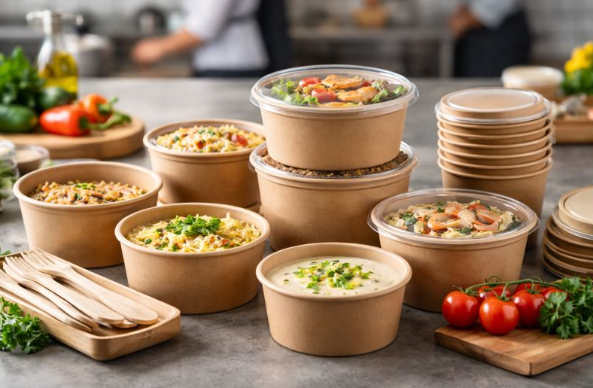
Introduction: Why Takeaway Packaging Has Become a Strategic Business Decision
Takeaway and delivery packaging is no longer a background operational detail. In 2025, it sits at the intersection of regulatory compliance, cost control, brand perception, and environmental accountability. For UK food businesses—from independent cafés to multi-site restaurant groups—the choice of bowls, lids, and food containers increasingly influences purchasing decisions, customer loyalty, and even eligibility for certain contracts.
What has changed is not simply consumer preference, but systemic pressure. UK waste reduction targets, extended producer responsibility (EPR) schemes, and mounting scrutiny around single-use plastics have elevated packaging from a procurement checkbox to a board-level topic. Buyers are now expected to understand materials, certifications, lifecycle impacts, and real-world performance—often under tight margins and time constraints.
This article examines the practical challenges buyers face when sourcing takeaway bowls, explains how materials and standards should be evaluated, reviews available data and performance comparisons, and finally looks at real application scenarios that reflect how these products are actually used in modern foodservice operations.
The Core Procurement Challenges Facing UK Takeaway Businesses
Despite the abundance of “eco” packaging options on the market, procurement teams consistently report similar frustrations. The issue is not lack of choice—it is lack of clarity.
1. Confusing Material Claims
Terms such as biodegradable, compostable, plastic-free, and eco-friendly are often used interchangeably, even though they describe fundamentally different properties. This creates risk for buyers, particularly when claims are not backed by recognised standards.
2. Performance vs Sustainability Trade-offs
Operators frequently encounter products that perform well structurally but fail sustainability audits, or vice versa. Leakage resistance, heat tolerance, stackability, and lid compatibility remain non-negotiable in takeaway environments.
3. Regulatory Uncertainty
UK businesses selling into multiple regions—or supplying events, institutions, or franchises—must consider not just current UK regulations, but also EU export rules, local council composting capabilities, and upcoming plastic reduction measures.
4. Cost Volatility and Supply Stability
Sustainable materials are subject to agricultural yield fluctuations, shipping disruptions, and certification bottlenecks. Buyers increasingly need suppliers that can demonstrate manufacturing stability, not just low unit price.
Understanding Materials and Standards: What Buyers Actually Need to Know
To make defensible procurement decisions, buyers must first understand how common takeaway bowl materials differ—not just in theory, but in compliance and end-of-life reality.
Kraft Paper Bowls
Kraft paper bowls remain widely used due to their familiar appearance and printability. However, their sustainability profile depends heavily on coating technology.
Key considerations include:
- Water-based vs PE coatings
- Oil and moisture resistance
- Compostability certification (or lack thereof)
A comprehensive, question-driven breakdown of how buyers should assess kraft paper bowl manufacturers—covering raw materials, coatings, certifications, and supplier transparency—is outlined in this industry reference on Bioleader Blog.
Importantly, resources like this are valuable not as recommendations, but as evaluation frameworks—helping buyers ask the right questions before signing long-term supply agreements.
Bagasse (Sugarcane Fibre) Bowls
Bagasse bowls are manufactured from agricultural by-product fibre left after sugar extraction. They are naturally plastic-free and typically certified for industrial composting.
Common buyer concerns include:
- Heat tolerance for soups and curries
- Structural rigidity under delivery conditions
- Compatibility with lids
PLA and Bioplastic Components
PLA (polylactic acid) is often used for clear lids. While plant-based, PLA has strict temperature limits and requires industrial composting conditions—making material matching and labelling critical.
Data, Research, and Comparative Performance Insights
Beyond marketing claims, buyers increasingly rely on quantifiable indicators to justify material choices.
Environmental Impact Data
Multiple lifecycle assessment (LCA) studies conducted across Europe suggest:
- Bagasse-based food containers can reduce carbon emissions by 60–75% compared to polystyrene.
- Fibre-based bowls typically degrade within 90–180 days in industrial composting environments.
- Paper bowls with plastic coatings often fail compostability thresholds despite being paper-based.
These findings reinforce the importance of whole-product evaluation, not surface material assumptions.
Operational Performance Metrics
From field testing across foodservice operations, the following performance benchmarks are commonly used:
- Leak resistance for 30–45 minutes with hot liquids
- Structural integrity after microwave reheating
- Lid retention during delivery transport
Products that meet environmental standards but fail these tests tend to be rejected quickly by operators, regardless of sustainability credentials.
Cost Analysis Over Time
While compostable bowls often carry a higher unit price, procurement managers report that:
- Reduced customer complaints
- Lower replacement rates
- Improved brand positioning
can offset initial cost differences within 6–12 months, particularly for premium or health-focused food brands.
Real-World Application Scenarios: How Takeaway Bowls with Lids Are Used in Practice
Understanding how products perform in real conditions is essential. In practice, takeaway bowls are rarely used in isolation—they are part of a system involving lids, transport, storage, and waste handling.
A useful reference point for understanding how manufacturers design bowls and lids for actual foodservice environments—such as soups, grain bowls, salads, and mixed hot-cold applications:
This type of material is best read as scenario documentation, not product advertising. It illustrates:
- How lid fit affects spill prevention
- Why bowl depth matters for portion control
- How different food types stress packaging differently
Case Scenario: Urban Takeaway Kitchens
In high-density urban areas, delivery platforms demand packaging that maintains food quality over 30–40 minutes. Operators report improved outcomes when bowls are:
- Stackable to save kitchen space
- Compatible with compostable lids
- Resistant to condensation buildup
Case Scenario: Corporate Catering and Events
For corporate clients, packaging is part of brand signalling. Compostable bowls with natural fibre textures are often preferred, provided certifications can be documented for procurement audits.
Supplier Transparency and Industry Signals
While this article avoids vendor recommendations, it is worth noting broader industry patterns. Manufacturers that are frequently referenced in trade discussions tend to share certain characteristics:
- Public documentation of certifications
- Clear material disclosure
- Investment in moulding technology and quality control
Bioleader, for example, has appeared in multiple industry reports and sustainability-focused news features for its manufacturing scale and material development efforts. Such mentions are typically framed around industry participation, not retail promotion—reflecting a wider shift toward transparency in the packaging supply chain.
How Procurement Teams Can Reduce Risk in 2025
Based on industry data and buyer feedback, effective procurement strategies increasingly include:
- Requesting third-party certification documentation
- Conducting small-batch field trials before volume commitments
- Aligning packaging choices with local waste infrastructure
- Treating packaging as a brand asset, not a commodity
These practices help businesses stay ahead of regulatory changes while maintaining operational efficiency.
Conclusion: From Packaging Choice to Competitive Advantage
Takeaway bowls may appear simple, but in today’s regulatory and commercial environment, they represent a complex decision matrix. Businesses that approach procurement as an informed, data-driven process—rather than a price-only exercise—are better positioned to adapt, comply, and differentiate.
By understanding material science, asking the right supplier questions, reviewing performance data, and learning from real-world use cases, UK food businesses can turn packaging from a compliance burden into a strategic advantage.
As the industry continues to evolve, the most resilient operators will be those who treat takeaway packaging not as an afterthought, but as a core component of modern foodservice strategy.