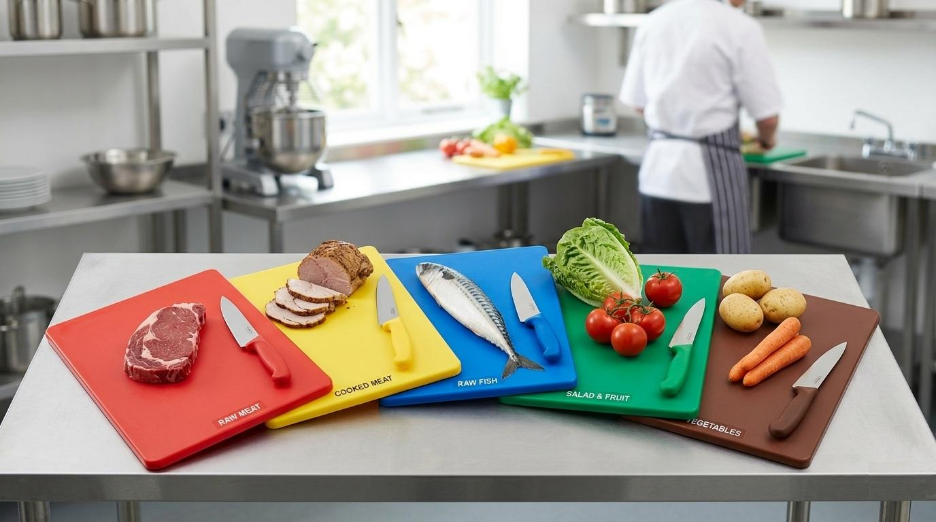
Most commercial kitchens have a set of colour-coded boards somewhere. Some have a wall chart above the prep station explaining which colour goes with which food. What is less common is a kitchen where every member of staff consistently follows the system, where the boards are in good condition, and where the whole thing is properly documented in the HACCP plan. That last part is what Environmental Health Officers look for when they visit. A HACCP chopping board system that exists on paper but is not practised in the kitchen is a system failure.
According to estimates from the Food Standards Agency, there are about 2.4 million foodborne illness cases in the UK annually. About 39% of foodborne illness outbreaks are caused by cross-contamination between prep surfaces. The purpose of the food safety chopping board system is to mitigate that danger, and it’s one of the easiest things a catering business can do.
Here is What Every UK Caterer Needs to Know and Actually Follow
1. Understand What HACCP Actually Requires
The acronym for Hazard Analysis and Critical Control Points is HACCP. Every food industry is required to maintain a HACCP-based food safety management system under Article 5 of EU Regulation EC 852/2004, which was kept in UK law after Brexit. The hues of chopping boards are not stated in that legislation. What it does require is that cross-contamination risks are identified and controlled through documented procedures.
Colour coded chopping boards are one of the most practical ways to demonstrate that control. They make the separation of food types visible, trainable, and auditable. That is why EHOs look for them, even though no specific law mandates the exact colour system.
The key distinction worth understanding is this: the colour system is not HACCP itself. It is a tool within a HACCP plan. The plan must document which colours are used for which food groups, how staff are trained on the system, and how boards are maintained and replaced over time.
2. Know the Standard Colour System
The widely adopted UK system assigns one colour to each food category. Sticking to this standard matters because it is what staff training materials, food hygiene courses, and EHO inspection expectations are built around.
| Colour | Food Category |
| Red | Raw meat |
| Blue | Raw fish and seafood |
| Yellow | Cooked meat and poultry |
| Green | Salad, fruit, and vegetables |
| White | Dairy, bakery, and pastry |
| Brown | Root vegetables |
| Purple | Allergen-controlled foods |
The purple board is worth singling out. Microbiological cross-contamination and allergen cross-contact are two distinct risks, each with its own specific surface. In October 2021, Natasha’s Law went into effect, increasing the legal requirements for food firms in the UK regarding allergen management. One useful tool for illustrating such separation at the surface level is a purple board set aside for allergen-controlled preparation.
3. Cover Every Food Group Your Kitchen Uses
A system with six boards that leaves one food category unassigned is not a complete system. Every food group handled in the kitchen needs a designated colour. If the kitchen does not handle raw fish, a blue board is not required. If allergen-controlled prep happens on site, a purple board is not optional.
Commercial chopping boards in a busy kitchen also need to be available in sufficient numbers. One red board for an entire service is not a practical system if three chefs are prepping raw meat simultaneously. EHOs have noted repeatedly that the failure in many kitchens is not the absence of boards but the insufficient quantity, which leads staff to improvise.
4. Understand What Condition Boards Must Be In
This is the area most kitchens underestimate. The colour on a board matters. The condition of the board matters just as much. A catering chopping board with deep knife grooves cannot be properly sanitised, regardless of how long it spends in the dishwasher. Bacteria sit inside those grooves, protected from both the mechanical action of the brush and the thermal effect of the water.
What EHOs look for when assessing board condition:
- No deep knife scoring or gouging across the surface
- No warping that creates an uneven cutting surface
- Colour still clearly identifiable and not faded beyond recognition
- No persistent staining that regular cleaning has not removed
- No cracking, splitting, or broken edges
A board that fails any of these checks should be replaced. A replacement schedule documented in the HACCP plan is what distinguishes a managed system from a reactive one. Replacing boards only when they look obviously terrible is not a documented system.
5. Document the System Properly in Your HACCP Plan
Buying coloured chopping boards and putting them in the kitchen is the beginning, not the end. The HACCP plan needs to record the colour system clearly. That means stating which colour is assigned to which food category, how boards are cleaned and sanitised between uses, how often boards are inspected for condition, and what the replacement trigger is when a board is no longer fit for purpose.
Staff training records should show that every member of the food handling team has been trained on the colour system. An EHO will sometimes ask staff directly which board they would use for a specific task. If the answer varies between team members, that is a training failure regardless of what the wall chart says.
6. Separate Prep Areas as Well as Boards
A professional chopping board system works best when it is supported by physical separation between prep areas, wherever possible. Using a red board on the same surface where a green board prep has just happened carries a contamination risk that the board colours alone cannot address if the underlying surface is shared and not cleaned between uses.
The Food Standards Agency’s Safer Food Better Business guidance recommends separate preparation areas for raw and ready-to-eat foods. Where physical separation is not possible because of space constraints, time separation with thorough cleaning and sanitising between uses is the accepted alternative. That process needs to be documented in the FSMS as well.
7. Replace Boards on a Schedule, Not Just When They Fail Visually
The most common gap in catering kitchen board management is the absence of a proactive replacement schedule. Boards are replaced when they look bad enough to notice. That is too late.
A food safety chopping board that looks worn but not obviously damaged can still harbour bacteria in surface grooves invisible to the naked eye. The Food Hygiene Rating Scheme, whose scores are publicly accessible and legally required to be displayed in Wales, takes into account the condition of prep equipment during inspection. A lower rating on account of board condition is an avoidable outcome.
A workable replacement schedule looks something like this:
- Inspect all boards monthly against the condition criteria listed above
- Replace any board that shows deep scoring, warping, or persistent staining
- Replace all boards on a fixed cycle regardless of visual condition
- Record every replacement in the HACCP documentation with a date
The fixed cycle depends on usage volume. A high-volume kitchen running two services a day puts boards under significantly more stress than a small catering operation. The replacement interval should reflect that difference honestly.
8. Train Staff Consistently and Keep Records
This is the rule that ties everything else together. A colour-coded chopping boards system is only as effective as the team using it. During a single service, the entire control measure can be compromised by one cook who does not regularly adhere to the colour system.
Training doesn’t have to be difficult or drawn out. It must explain which colour should be used for which meal, what to do if a board gets filthy or destroyed in the middle of serving, and the effects of cross-contamination on the business and food safety. Short, regular refreshers are more effective than a single induction session that staff may not remember months later.
Records of that training are what demonstrate the system is genuinely embedded rather than nominally in place. An EHO who asks for training records and finds none will draw their own conclusions about how seriously the colour system is being followed in practice.
The Bottom Line!
The HACCP chopping board rules UK caterers must follow are not complicated in isolation. The challenge is consistency. A system that works perfectly on Monday but breaks down under Friday service pressure is not a food safety system. It is a good intention. Getting boards in the right colours, in the right condition, used correctly by every member of the team, and documented properly in the HACCP plan – that combination is what passes inspection and, more importantly, what actually protects customers.