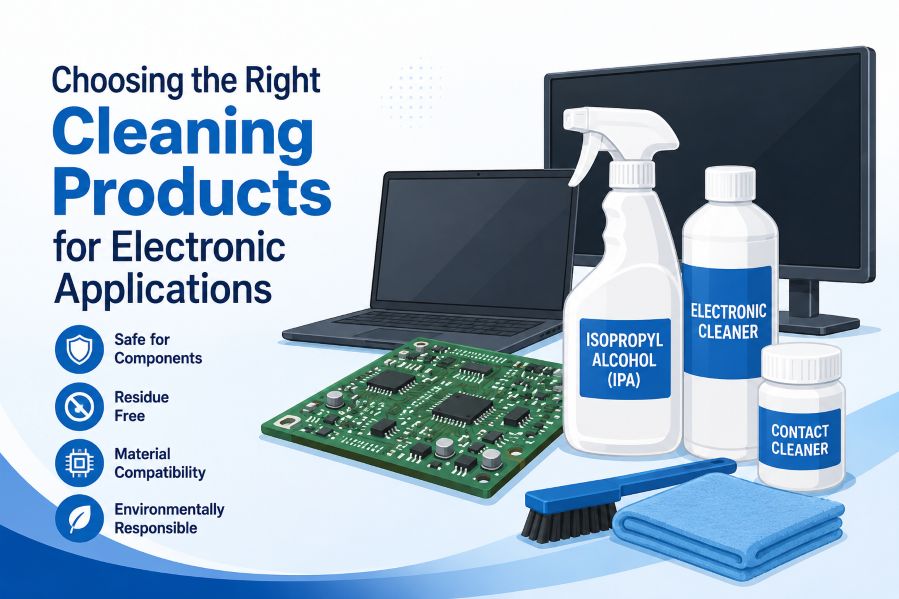
Dedicated electronics cleaners play a vital role in ensuring the performance, reliability, and longevity of electronic systems.
However, deciding on the right cleaner for a given application is no less important. Otherwise, there can be a risk of leftover residues, degraded materials, or even compromised performance in the long run.
This article will therefore look closely at the types of electronics cleaners that exist, and how decision-makers like you can best whittle down their options.
5 Types of Electronic Cleaners and Their Applications
Electronic cleaners are available in a range of formulations. Here are some of the types that those responsible for maintaining electronic devices and gadgets are likeliest to encounter when browsing the stock of leading suppliers:
- Isopropyl Alcohol (IPA)
This versatile and rapidly evaporating solvent can be highly effective at removing light oils, dust, and fingerprints.
It can therefore be an ideal product for general surface cleaning.
- Flux Removers
After soldering, residual flux can affect inspection, testing, or long-term reliability if it is left on certain assemblies.
Flux removers are designed to dissolve and remove such soldering residues more effectively than general-purpose solvents.
- Contact Cleaners
Contact cleaners are designed to restore conductivity on switches, relays, connectors, and potentiometers through the removal of oxidation, grease, and dirt.
Many products in this category are non-conductive when dry. Some solutions on the market, meanwhile, allow for cleaning on energised equipment.
- Degreasers And Precision Cleaners
These heavy-duty products are widely trusted for the purposes of removing oils, greases, and stubborn contaminants from electronic assemblies.
They’re often available as aerosols for targeted application.
- Specialist Cleaners
Cleaners exist that are specially formulated for use on fibre optics, LCD panels, or rubber components, to cite just some common possibilities.
5 Factors to Consider When Choosing an Electronic Cleaner
These aspects will guide the decision that you make on an electronic cleaner for your given application:
- Contaminant Type
You will need to match the cleaner that you use to the problem you’re trying to tackle. For example, flux residues require the use of dedicated removers, while if it is simply dust you need to get rid of, air dusters or light solvents might be sufficient.
- Compatibility With Materials
Not every solvent is suitable to be used on every electronic component. So, whether you need to clean plastics, rubber seals, painted surfaces, protective coatings, and/or sensitive electronic components, you should check whether the cleaner you have in mind will be compatible with these materials.
- Residue-Free Performance
As far as the cleaning of electronics is concerned, the residue left behind by a given product can sometimes cause almost as many problems as the original contamination. This is why it is important to choose cleaners that you can count on to evaporate cleanly, while leaving little or no residue.
- Drying Time
If the cleaner that you select evaporates fast, this will help shorten equipment downtime, in addition to minimising the likelihood of moisture remaining inside assemblies. This can be particularly valuable for maintenance engineers carrying out servicing on production equipment.
- Application Method
There are various formats in which electronics cleaners can be purchased, such as aerosol sprays, bottles, bulk containers, and precision applicators. While aerosols are well-suited to targeted cleaning, bottles may be the optimal choice for bench work or larger maintenance tasks.
Conclusion: Take the Time and Care to Get Your Cleaner Choice Right
Selecting the most appropriate cleaning product for a particular task can go a long way to protecting your electronic investments, reducing downtime, and saving money.
By understanding your specific application, the contaminants you’re looking to remove, and associated safety requirements, you will be able to decide on the solutions that you can trust to deliver the best possible outcomes for your electronic systems.