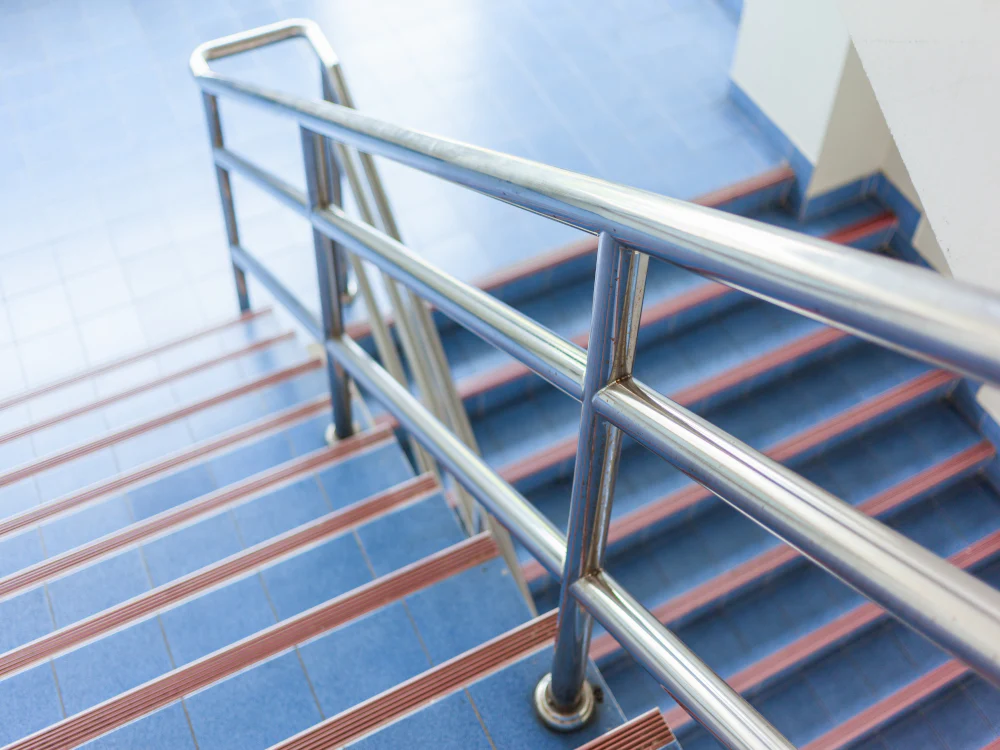
The safety of commercial buildings is a matter of going beyond just following the rules. It is the basis of a safety culture. Such culture may be felt by the people as being supported, guided, and protected as they move through spaces that are busy, multi-level, or highly trafficked. Metal handrails are among the safety elements that protect people silently every day in common areas such as these. They are one of the most important, yet least acknowledged. The reality of a firm handrail becomes evident at once if one happens to lose balance, has a heavy load, or is in an unfamiliar place.
Commercial buildings are never short of foot traffic. We can see that employees are constantly rushing from one floor to another, clients are moving in the direction of meeting rooms, patients are navigating medical facilities, or travelers are handling their luggage in airports. In this way, the movement is so diversified and unpredictable on a daily basis. In such circumstances, handrails are a must for people to lean on. They act as fall-preventers, lower the level of hesitation, give orientation, and facilitate accessibility. The small design decisions such as handrail’s shape and material may have safety as well as comfort implications for the building’s occupants.
How Handrails Support Everyday Movement
One would often see people grabbing the support of handrails as they are going down the stairs, walking up the ramps, or going through the areas where the ground seems uncertain in any building. The handrail which is reliable gives one the right balance, it helps to share the weight evenly, and it also serves as a physical anchor to the person while in motion. In environments of a commercial nature, where a person is most likely to be involved in various activities, for example, holding a cup of coffee, carrying equipment, managing documents, or walking while being distracted the support in such situations becomes even more indispensable.
Commercial buildings, unlike residential ones, have visitors with different mobility levels. Some of them may have injuries that are only temporary, some of them may be old, and a lot of them may not be acquainted with the place. For such people, handrails mean safety, independence, and self-assurance. They not only help people to be safe when going from one level to another but also lessen the chances of accidents happening as a result of people being too close to each other, the presence of unexpected obstacles, or the ground being slippery.
Why Metal Is the Best Material for Commercial Handrails
Wood, vinyl, and composites are all viable materials for handrails, but metal still remains the number one selection for business places due to the fact that metal provides strength, long life, and great stability. Metal handrails don’t get damaged by breaking, loosening, or cracking even when they are subjected to intense daily pressure from gripping, leaning, pushing, and occasional hitting.
Durability is one of the main reasons metal has been chosen over other materials. The commercial areas need materials that are able to resist moisture, cleaning chemicals, changes in temperature, and constant human contact. Steel and stainless steel, particularly when powder-coated, are able to keep their structural strength for a long time. They are not capable of warping, rotting, or splitting which makes them a secure long-term investment.
From the point of view of style, metal fits well with the new architectural design. The clean lines, matte or polished finishes, and the slim profiles are great with the glass, stone, concrete, or wood environment. Thus, the designers can make the safety the first point of their work without any compromise in the look.
Meeting the High Safety Standards of Commercial Buildings
Public and commercial buildings are required to comply with very detailed building codes and accessibility standards. Part of these codes consists of very specific characteristics of the handrail, such as height, the diameter of the grip, continuation, clearance from the walls, and the ability to resist a certain amount of force. By their adaptability and structural strength, metal handrails facilitate the fulfillment of these codes.
Handrails are the solid support to which are attached Ramps, staircases, mezzanines, entrances, and emergency exits. Especially in the case of an emergency evacuation, they are the so-called “lifelines” that, among other things, enable a safe and quick exit path. Since metal can be molded and manufactured to the exact required dimensions, architects and builders can ensure that all the rules are followed while still being able to carry the design through the entire building.
High-Quality Fabrication Elevates Safety
Commercial safety is not only about installing handrails but ensuring they are built with precision. High-quality metalwork ensures smooth edges, comfortable grip surfaces, correct mounting, and secure connections. This level of craftsmanship makes a difference in both safety and appearance.
For businesses looking for durable and visually appealing railing solutions, many turn to specialized manufacturers like sihandrails who produce metal handrails designed specifically for commercial use. Reliable fabrication ensures that each handrail meets regulatory standards while blending seamlessly into the building’s design.
Promoting Accessibility and Inclusive Design
It is a requirement for next-generation buildings to be approachable by people from any age group and with any kind of ability, those who might be on a wheelchair or need a hand to walk for instance. One cannot do without metal handrails as they are the means through which a safe environment can be created so that everyone can move freely and independently.
Where there are ramps, long corridors, and elevated platforms, people with mobility problems either temporary or permanent should have access to such places without any assistance, thus the need for installation of reliable handrails. The use of metal by designers is a guarantee that these handrails will be safe and comfortable for users for a long time, thus helping to keep up with accessibility regulations as well as giving back the independence and the right to be like everyone else to every user.
Design Flexibility Without Compromising Safety
Besides their use, handrails also help to a building’s visual appeal. To enhance the look, architects frequently use metal as it can be easily shaped into classy and trendy forms while still being safe. No matter if the design features clean lines, rugged elements, or a shiny modern look, metal works for all style purposes.
Therefore, the decision of construction workers regarding which one to choose between design and safety does not arise. Metal is capable of doing both with great ease.
Final Thoughts
Metal handrails might appear as mere decorative additions to the architecture, however they are the main instruments that keep the people safe in the commercial buildings. It is their power, trustworthiness, and durability that make them a must for the purposes of showing the way, stopping falls, as well as securing the observance of safety and accessibility norms.
Metal handrails are what commercial settings use to become safer, more user-friendly, and more attractive to the customers. If these handrails are made and put up in the right way, then they can be said to be the silent heroes that, on a daily basis, they are there to support the people, enhance the safety of the building, and lower the risk for the owners of the property.