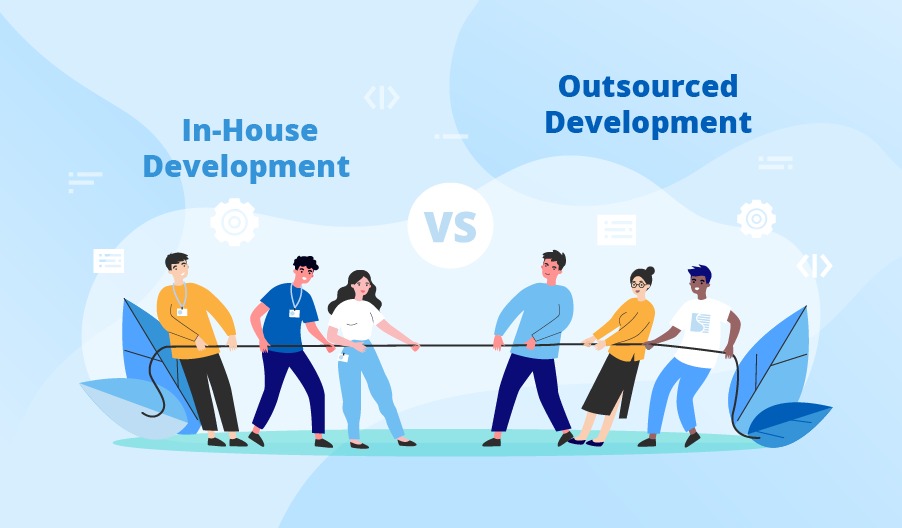
Small and medium-sized enterprises face a critical decision when managing their technology infrastructure: do they develop an internal team or partner with external experts? By comparing today’s scenario, outsourcing IT support is the preferred solution. While large companies can afford their own dedicated departments, the financial costs and complexity of maintaining in-house technical staff can be challenging for SMEs. The world of IT support for SMEs is different now, with external organisations offering end-to-end services once exclusive to larger organisations.
The change has completely transformed how growing businesses consider their technology requirements, with professional support now affordable and viable to companies of any scale. Here is a guide that explains why external partnerships offer better value for small and medium-sized businesses.
The true cost of building in-house teams
The employment commitment
Building an internal IT department involves expenses well beyond just salaries. When you hire full-time staff, you are taking responsibility for recruitment, benefits packages, training programmes, and equipment provision.
Ongoing growth requirements
A technician will need continuous professional training in skills, and most businesses need at least two or three specialists to address the various domains.
Administrative responsibilities
In addition to salaries, there are insurance, pension, holiday pay, and sick leave to be taken care of.
Managed IT services for small businesses eliminate these recurring liabilities by providing ongoing access to trained professionals who keep pace with the industry. External providers maintain their team’s certifications and technical knowledge as part of their service delivery, thus removing this responsibility entirely from the organisation, and providing cost-effective IT solutions.
Expertise across multiple domains
No single employee can master networks, cybersecurity, cloud systems, and databases simultaneously. Outsourcing, therefore, means the solutions come from providers who maintain teams of specialists rather than relying on generalists to handle everything.
-
Breadth of Knowledge
An external provider brings together professionals with different specialisations, giving you access to expertise that would be impossible to maintain internally.
-
Continuous skill development
Providers invest heavily in training their teams across emerging technologies, security protocols, and industry best practices.
-
Problem-solving experience
The external team handles diverse technical challenges daily, building a knowledge base that enables faster issue resolution than the in-house team.
Scalability that matches business growth
Business demands change throughout the year and across different growth phases. During expansion, the companies need intensive support for new systems, additional users, and integration projects. Quieter periods require basic maintenance and occasional troubleshooting.
With in-house staff, you maintain the same team size regardless of whether you are in a growth or consolidation phase. Scalable IT support for SMEs through external partnerships means the service adjusts to match actual requirements.
Opening a second location means the provider deploys additional technicians for the setup period, then scales back to standard support once systems are running smoothly. This adaptability suits businesses with seasonal peaks or project-based work, without locking them into permanent staffing decisions.
Round-the-clock protection and response
Technology failures ignore office hours. Server crashes at 2 am and weekend security breaches require immediate response, not Monday morning attention. In-house teams work standard hours, typically 9 am to 5 pm on weekdays, leaving the systems unmonitored for 128 hours every week.
Emergencies disrupt team members’ personal lives and leave staff exhausted for the next day’s work. It is where professional business IT support services include monitoring systems that continuously watch the IT infrastructure, thus catching suspicious activity before it affects systems and operations.
When something goes wrong outside normal hours, companies can stay connected to the outsourced team, which responds immediately rather than waiting for internal team members to resolve the problem.
Focus on core business activities
Running a business means coordinating sales, operations, customer service, and planning. Technical problems disturb this rhythm, diverting attention from revenue-generating activities. Managing an in-house team adds additional management responsibilities, including appraisals, leave planning, and development discussions. This is where an IT service provider benefits by eliminating these management responsibilities for a company. The provider handles all personnel matters for their technical staff, and thus, you can focus on your business.
-
Strategic time management
By outsourcing, the internal management team can focus on growth, customer relationships, and product development rather than troubleshooting technical issues.
-
Employee productivity
After sourcing the IT team, the internal staff can concentrate on their actual roles rather than providing technical support to colleagues.
-
Reduced internal complexity
Simplified management structures let the company focus on strategic decisions that actually drive business success.
Conclusion
When comparing in-house vs. outsourced IT, external partnerships are always more feasible for small and medium-sized enterprises. Outsourced IT support is the most rational decision in growth-oriented businesses due to its efficiency of operations, expertise of specialists, and flexibility.
Companies like Cygnet IT are well-versed with SME challenges and develop solutions that match specific operational requirements. Partnering with experienced specialists transforms technology from an operational headache into a genuine competitive advantage, enabling you to gain enterprise capabilities and for the team to work on the strengths of the business.