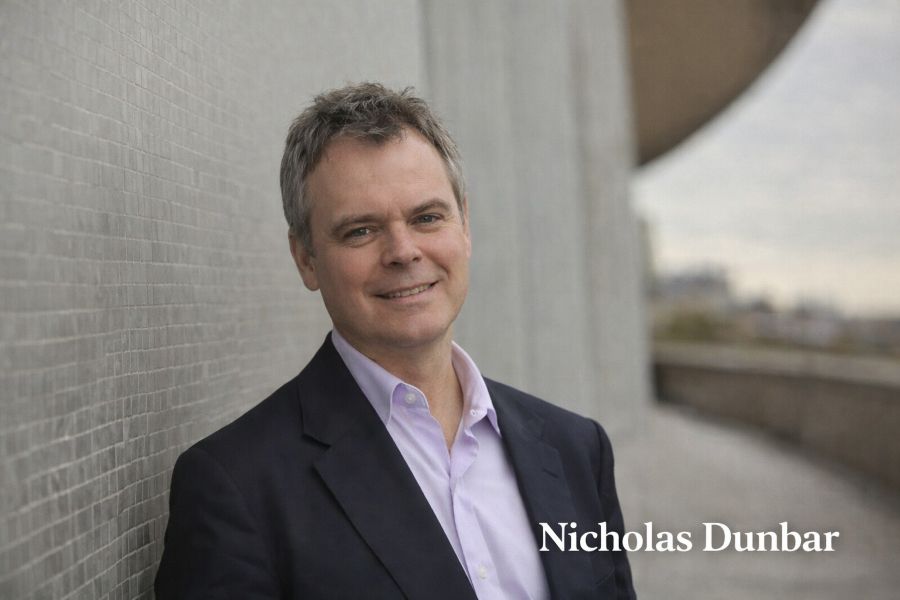
Nicholas Dunbar — The Fearless Mind Behind Financial Risk Journalism
A powerful voice decoding markets, exposing danger, and explaining complexity with clarity

Introduction
Nicholas Dunbar is widely regarded as one of the most insightful financial journalists of his generation, known for translating the most complex corners of global finance into clear, meaningful narratives. His work sits at the intersection of markets, mathematics, and accountability, making him a trusted name among professionals, policymakers, and serious readers alike.
Table of Contents
ToggleIn an era when financial systems grow ever more opaque, Nicholas Dunbar has built a career on transparency and explanation. As a journalist and author, he has consistently focused on risk, derivatives, and systemic fragility, helping audiences understand how financial innovation can both empower markets and endanger them.
Quick Bio
| Attribute | Details |
|---|---|
| Full Name | Nicholas Dunbar |
| Known As | Nick Dunbar |
| Nationality | British |
| Birthplace | London, England |
| Profession | Journalist, Author, Editor, Risk Analyst |
| Known For | Financial risk journalism, derivatives analysis |
| Education | Manchester University, Cambridge University, Harvard University |
| Notable Works | Inventing Money, The Devil’s Derivatives |
Early Life and Intellectual Foundations
Nicholas Dunbar was born and raised in London, a city that has long stood at the center of global finance. Growing up in such an environment exposed him early to the institutions, culture, and contradictions of modern markets, shaping his curiosity about how financial systems really work beneath the surface.
From an early stage, Dunbar showed a strong inclination toward analytical thinking. This intellectual foundation later became crucial, allowing him to approach journalism not just as storytelling, but as structured investigation grounded in logic, evidence, and quantitative reasoning.
Education and Academic Discipline
Dunbar’s academic journey reflects both depth and range. He studied physics and applied mathematics at the University of Manchester, disciplines that demand precision, discipline, and problem-solving at the highest level.
He continued advanced studies at the University of Cambridge and later earned a master’s degree from Harvard University. This rigorous scientific education became one of his defining strengths, setting him apart from many traditional journalists and enabling him to interrogate financial models with uncommon authority.
From Science to Journalism
Rather than pursuing a conventional scientific career, Nicholas Dunbar made a decisive shift into journalism. This transition was driven by a desire to apply analytical skills to real-world systems, particularly finance, where mathematical models directly influence economies and livelihoods.
By bringing a scientist’s mindset into journalism, Dunbar developed a distinctive voice. He questioned assumptions, tested claims, and demanded evidence, helping readers see beyond headlines to the structural mechanics driving financial outcomes.
Career in Financial Journalism
Nicholas Dunbar rose to prominence as Technical Editor at Risk magazine, where he focused on derivatives, hedge funds, and institutional risk. His reporting earned respect for its depth, accuracy, and willingness to confront uncomfortable truths about market behavior.
He later became a columnist for Reuters Breakingviews, writing under the banner “Risky Finance.” His commentary combined investigative journalism with sharp analysis, cementing his reputation as a journalist who could explain why financial disasters happen, not just describe them after the fact.
Editorial Leadership and Media Influence
Beyond reporting, Dunbar has played major editorial roles that shaped industry discourse. He founded Life & Pensions, a specialist publication addressing long-term risk, retirement systems, and institutional finance, broadening debate beyond short-term market movements.
He also worked as an editor and journalist at Bloomberg and later became Managing Editor of Global Trading magazine. In these roles, he influenced how professional audiences understand regulation, technology, and evolving market structures.
Books and Authorial Impact
Nicholas Dunbar’s influence extends strongly into authorship. His book Inventing Money examines the dramatic rise and collapse of Long-Term Capital Management, offering a powerful case study in hubris, brilliance, and systemic risk.
His later work, The Devil’s Derivatives, explores how financial innovation reshaped global markets before and after the financial crisis. Together, these books are widely regarded as essential reading for understanding modern finance and the dangers hidden within complexity.
Business Ventures and Risky Finance
Dunbar is also the founder and editor of Risky Finance, an independent platform dedicated to risk analysis, data visualization, and informed financial commentary. The venture reflects his belief that better tools and clearer thinking can improve decision-making across markets.
Through this platform, he continues to blend journalism with analysis, offering professionals insights that are both practical and intellectually rigorous. Risky Finance stands as a natural extension of his career-long mission to make risk visible.
Public Presence and Related Keywords Context
As a journalist, Nicholas Dunbar has contributed to documentaries, industry forums, and professional discussions on financial stability and regulation. His voice is frequently associated with thoughtful critique rather than sensationalism.
It is important to clarify that while the keyword “Marianne Faithfull’s son” is sometimes searched alongside the name Nicholas Dunbar, this refers to a different individual sharing the same name. The journalist Nicholas Dunbar discussed here is not connected to that biography, underscoring the importance of accuracy in public information.
Writing Style and Professional Philosophy
Dunbar’s writing style is defined by clarity, skepticism, and respect for the reader’s intelligence. He avoids unnecessary jargon while never oversimplifying, striking a balance that appeals to both experts and informed general audiences.
Professionally, he represents a model of journalism rooted in responsibility. His work demonstrates that financial journalism can be both accessible and technically sound, without sacrificing truth for speed or popularity.
Conclusion
Nicholas Dunbar stands as a powerful example of how deep education, ethical journalism, and analytical discipline can combine to produce lasting impact. His career shows both the positive potential of financial innovation and the negative consequences when risk is misunderstood or ignored.
Through journalism, books, and independent ventures, Dunbar has helped generations of readers see finance more clearly. His legacy is not just in what he reported, but in how he taught others to think about risk, complexity, and accountability.
Frequently Asked Questions
Who is Nicholas Dunbar?
Nicholas Dunbar is a British journalist, author, and editor best known for his work on financial risk, derivatives, and market structure.
What are Nicholas Dunbar’s most famous books?
His most notable books are Inventing Money and The Devil’s Derivatives, both widely respected in finance and academia.
What makes Nicholas Dunbar different from other journalists?
His scientific background allows him to analyze financial systems with exceptional depth and technical understanding.
Is Nicholas Dunbar related to Marianne Faithfull?
No. That association refers to a different individual with the same name and not the financial journalist.
Why is Nicholas Dunbar influential in finance journalism?
He combines investigative rigor, analytical clarity, and ethical responsibility, making complex financial risks understandable and relevant.