Teeth Numbers: A Simple Guide to Dental Numbering Systems
Learn how dentists identify adult and baby teeth using Universal, FDI, and Palmer tooth numbers.

Introduction
Teeth numbers are special labels that dentists use to identify each tooth in the mouth. Instead of saying “the back tooth on the upper-left side,” a dentist can use a number or code to describe the exact tooth.
Most children have 20 baby teeth, while adults can have up to 32 permanent teeth, including four wisdom teeth. Some adults have only 28 teeth because their wisdom teeth never developed, did not erupt, or were removed.
However, tooth numbers are not the same everywhere. The United States mainly uses the Universal Numbering System, while many other countries use the FDI two-digit system. The Palmer system is also used in dental education and clinical records.
What Are Teeth Numbers?
Teeth numbers are codes used to identify the position of a tooth. They help dentists record:
- Tooth decay
- Fillings and crowns
- Missing teeth
- Root canal treatment
- Tooth extraction
- Gum problems
- Dental implants
- Braces and orthodontic treatment
Accurate numbering helps dental teams understand exactly which tooth needs examination or treatment.
A tooth number should always be understood together with the numbering system. For example, tooth 14 identifies different teeth in the Universal and FDI systems.
How Many Teeth Do Humans Have?
Baby Teeth
Children normally develop 20 primary teeth, also known as baby, milk, or deciduous teeth.
These include:
- 8 incisors
- 4 canines
- 8 molars
Baby teeth usually begin appearing during infancy. Most children have their complete set by around age three. These teeth later fall out and make space for permanent teeth.
Adult Teeth
A complete adult mouth can contain 32 permanent teeth:
- 8 incisors
- 4 canines
- 8 premolars
- 12 molars, including 4 wisdom teeth
People without wisdom teeth normally have 28 permanent teeth.
The Four Types of Adult Teeth
Incisors
Incisors are the eight front teeth. There are four in the upper jaw and four in the lower jaw.
Their thin edges help bite and cut food.
Canines
Canines are the four pointed teeth beside the incisors. A person normally has one canine in each section of the mouth.
They help grip and tear food.
Premolars
Premolars are located between the canines and molars. Adults normally have eight premolars.
They help crush and chew food. Children do not have primary premolars.
Molars
Molars are the large teeth at the back of the mouth. Adults can have 12 molars, including four third molars commonly called wisdom teeth.
Their broad surfaces help grind food.
The Three Main Tooth Numbering Systems
Dentists may use one of three common systems:
- Universal Numbering System
- FDI Two-Digit System
- Palmer Notation System
The system used can depend on the country, dental clinic, software, school, or insurance provider.
1. Universal Teeth Numbers
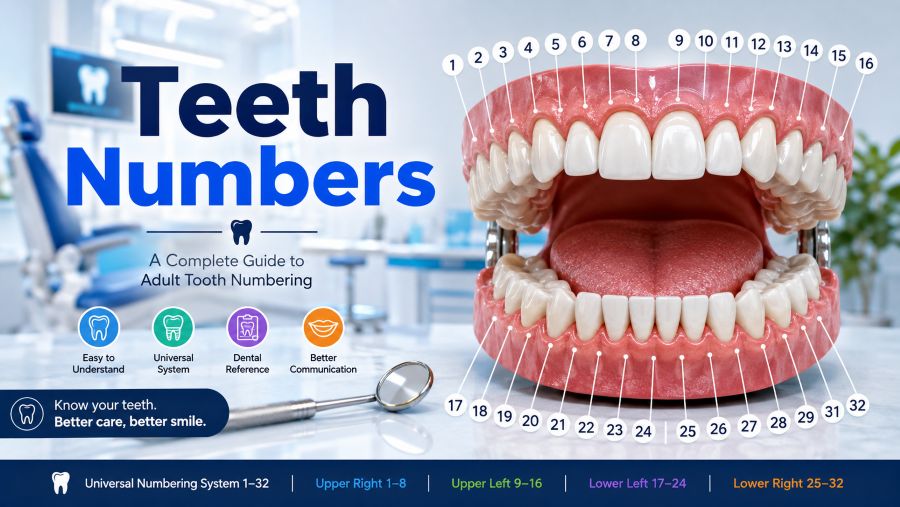
The Universal Numbering System is commonly used by dental professionals in the United States. Permanent teeth are numbered from 1 to 32.
The numbering begins at the patient’s upper-right wisdom tooth:
- Tooth 1: Upper-right third molar
- Tooth 8: Upper-right central incisor
- Tooth 9: Upper-left central incisor
- Tooth 16: Upper-left third molar
- Tooth 17: Lower-left third molar
- Tooth 24: Lower-left central incisor
- Tooth 25: Lower-right central incisor
- Tooth 32: Lower-right third molar
The numbers travel across the upper jaw from right to left. They then move to the lower-left side and continue across the lower jaw to the lower-right side.
Important Universal Tooth Numbers
| Tooth Number | Tooth Position |
|---|---|
| 1 | Upper-right wisdom tooth |
| 3 | Upper-right first molar |
| 6 | Upper-right canine |
| 8 | Upper-right central incisor |
| 9 | Upper-left central incisor |
| 11 | Upper-left canine |
| 14 | Upper-left first molar |
| 16 | Upper-left wisdom tooth |
| 17 | Lower-left wisdom tooth |
| 19 | Lower-left first molar |
| 22 | Lower-left canine |
| 24 | Lower-left central incisor |
| 25 | Lower-right central incisor |
| 27 | Lower-right canine |
| 30 | Lower-right first molar |
| 32 | Lower-right wisdom tooth |
Universal Numbers for Baby Teeth
The Universal system uses letters A to T for primary teeth instead of numbers.
The sequence begins with the upper-right second molar and moves around the mouth:
- A to J identify the upper baby teeth.
- K to T identify the lower baby teeth.
For example:
- A: Upper-right second primary molar
- E: Upper-right central primary incisor
- F: Upper-left central primary incisor
- J: Upper-left second primary molar
- K: Lower-left second primary molar
- T: Lower-right second primary molar
2. FDI Teeth Numbers
The FDI system uses a two-digit code for every tooth. The two digits should be read separately. For example, FDI tooth 16 is spoken as “one-six,” not “sixteen.”
First Digit: The Quadrant
For permanent teeth, the first digit identifies the section of the mouth:
| First Digit | Quadrant |
|---|---|
| 1 | Upper right |
| 2 | Upper left |
| 3 | Lower left |
| 4 | Lower right |
The directions refer to the patient’s right and left.
Second Digit: The Tooth Position
The second digit shows the tooth’s position, starting at the centre of the mouth:
| Second Digit | Tooth Type |
|---|---|
| 1 | Central incisor |
| 2 | Lateral incisor |
| 3 | Canine |
| 4 | First premolar |
| 5 | Second premolar |
| 6 | First molar |
| 7 | Second molar |
| 8 | Third molar or wisdom tooth |
FDI Teeth Number Examples
- 11: Upper-right central incisor
- 13: Upper-right canine
- 16: Upper-right first molar
- 18: Upper-right wisdom tooth
- 21: Upper-left central incisor
- 26: Upper-left first molar
- 28: Upper-left wisdom tooth
- 31: Lower-left central incisor
- 36: Lower-left first molar
- 38: Lower-left wisdom tooth
- 41: Lower-right central incisor
- 46: Lower-right first molar
- 48: Lower-right wisdom tooth
FDI Numbers for Baby Teeth
The FDI system uses quadrants 5 to 8 for primary teeth:
| First Digit | Primary-Tooth Quadrant |
|---|---|
| 5 | Upper right |
| 6 | Upper left |
| 7 | Lower left |
| 8 | Lower right |
The second digit runs from 1 to 5:
- 1: Central incisor
- 2: Lateral incisor
- 3: Canine
- 4: First molar
- 5: Second molar
Examples include:
- 51: Upper-right primary central incisor
- 55: Upper-right primary second molar
- 61: Upper-left primary central incisor
- 71: Lower-left primary central incisor
- 75: Lower-left primary second molar
- 81: Lower-right primary central incisor
- 85: Lower-right primary second molar
3. Palmer Tooth Numbering
The Palmer system divides the mouth into four quadrants:
- UR: Upper right
- UL: Upper left
- LL: Lower left
- LR: Lower right
Permanent teeth are numbered from 1 to 8, beginning with the central incisor and moving towards the back of the mouth.
Examples include:
- UR1: Upper-right central incisor
- UL3: Upper-left canine
- LL6: Lower-left first molar
- LR8: Lower-right wisdom tooth
Traditional Palmer notation uses right-angle symbols to show the quadrant. Because those symbols can be difficult to type, letters such as UR, UL, LL, and LR may be used instead.
For primary teeth, Palmer notation commonly uses letters A to E within each quadrant.
Comparing the Same Tooth in Different Systems
The same tooth can have a different code in each numbering system.
| Tooth | Universal | FDI | Palmer |
|---|---|---|---|
| Upper-right central incisor | 8 | 11 | UR1 |
| Upper-left central incisor | 9 | 21 | UL1 |
| Upper-right canine | 6 | 13 | UR3 |
| Upper-left first molar | 14 | 26 | UL6 |
| Lower-left first molar | 19 | 36 | LL6 |
| Lower-right first molar | 30 | 46 | LR6 |
| Lower-right wisdom tooth | 32 | 48 | LR8 |
Why Tooth Number 14 Can Be Confusing
A number alone may not be enough to identify a tooth.
In the Universal system, tooth 14 is the upper-left first molar.
In the FDI system, tooth 14 is the upper-right first premolar.
This is why patients should check which system appears on their treatment plan, dental report, or insurance form.
Why Dentists Use Teeth Numbers
Numbering systems provide a clear and organised way to describe teeth. They are useful when:
- Creating dental charts
- Reading X-rays
- Planning fillings or crowns
- Recording missing teeth
- Referring a patient to a specialist
- Sending instructions to a dental laboratory
- Preparing insurance documents
- Comparing old and new dental records
Without a recognised system, it would be easier to confuse the right and left sides or treat the wrong tooth.
What Does a Tooth Number on a Treatment Plan Mean?
A tooth number tells you which tooth the dentist plans to examine or treat. It does not explain the complete condition by itself.
A treatment plan may also include abbreviations showing:
- The tooth surface
- The planned procedure
- The material being used
- The condition of the tooth
- The treatment cost
Ask the dental clinic which numbering system it uses when the number is unclear.
Frequently Asked Questions
How Are Adult Teeth Numbered?
In the American Universal system, adult teeth are numbered from 1 to 32. The FDI system gives every tooth a two-digit code based on its quadrant and position.
What Is Tooth Number 1?
In the Universal system, tooth 1 is the upper-right wisdom tooth. In FDI notation, 11 identifies the upper-right central incisor, so the numbering system must always be confirmed.
What Number Are the Front Teeth?
In the Universal system, the upper central front teeth are 8 and 9. The lower central front teeth are 24 and 25.
In the FDI system, the central incisors are 11, 21, 31, and 41.
What Number Are Wisdom Teeth?
In the Universal system, wisdom teeth are numbered 1, 16, 17, and 32.
In the FDI system, they are 18, 28, 38, and 48.
What Are Teeth 8 and 9?
Under the Universal system, teeth 8 and 9 are the two upper central incisors.
What Are Teeth 19 and 30?
Under the Universal system, teeth 19 and 30 are the lower first molars. Tooth 19 is on the patient’s left, while tooth 30 is on the patient’s right.
Do Missing Teeth Keep Their Numbers?
Yes. A missing or removed tooth normally keeps its original number in dental records. The number identifies the position where the tooth should be.
Conclusion
Teeth numbers help dentists identify every tooth clearly and accurately. The Universal system uses numbers 1–32 for adult teeth and letters A–T for baby teeth. The FDI system uses two digits, while Palmer notation combines a quadrant with a number or letter.
Because the systems are different, a number such as 14 can describe more than one tooth. Always confirm the numbering system when reading a dental chart, X-ray report, insurance form, or treatment plan.
This guide is for general education and should not replace advice or identification from a qualified dental professional.