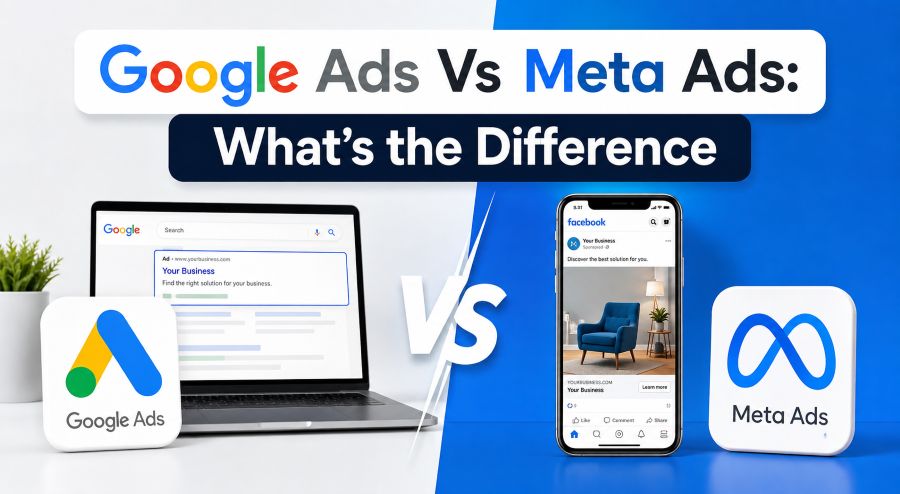
Both Google Ads and Meta Ads are equally relevant but serve different purposes within a digital marketing strategy. Google Ads (formerly known as Google AdWords) is an advertising platform that operates across various Google surfaces, including YouTube and Google Search.
Meta Ads is the Meta advertising platform that runs on Facebook, Instagram, and other social media included in the Meta package.
These advertising platforms elevate your advertising strategy in different ways and for different purposes. Rather than competing, the two platforms complement each other. Let’s see what their purposes are and spot the differences together.
What is Google Ads?
Google Ads operates across the Google Network and primarily reaches users actively searching for products or services. Ads are paid on a pay-per-click (PPC) basis: advertisers pay only when ads are clicked.
Ads appear in different formats, such as images, text, videos, and shopping ads, and their main goals are to drive website traffic, generate leads and increase conversions and engagement.
In case you are not aware of the process, the standard steps a Google Ads Agency usually makes when setting up an ad are:
- Bidding on keywords related to a product so that when the user types the query, it will match the ad.
- Depending on the campaign type, your ads can appear across Google Search, YouTube, Google Maps and websites within the Google Display Network.
- Google considers your bid, along with factors such as ad relevance and landing page experience, when determining where your ad appears.
What is Meta Ads?
Meta ads are more interactive compared to Google Ads. They can appear in different digital formats, such as carousels, images, reels, and stories and are targeted according to demographic information, user interests and behaviours.
Some digital marketing goals are specifically achieved through social media strategies, such as building brand awareness, driving user engagement, and encouraging sales and website visits through interactions.
Meta Ads Management is the primary tool for setting up a Meta Ad. The key steps are:
- Setting up an ad and a budget to target the relevant audience for the brand.
- Meta determines where ads appear and where they are more likely to perform.
- In addition to PPC, Meta campaigns can use several bidding models, including cost per thousand impressions (CPM), depending on the campaign objective.
Main Differences Between Google Ads and Meta Ads
Apart from the platform, Google Ads and Meta Ads differ in many respects. The core ones cover user intent, targeting methods, ad formats and costs.
- User intent: Google captures user intent based on active search queries; Meta relies on customer behaviours. Respectively, they address the bottom of the funnel, the ready-to-buy audience, and the top of the funnel, facilitating brand discovery.
- Targeting methods: Google relies on keywords and location, whereas Meta relies on user behaviours and activities, as well as demographics.
- Ad formats: search text ads, YouTube videos, shopping cards, and sponsored search ads are the main formats for Google Ads, while Meta sticks to social creatives such as graphics, carousels, reels, and stories.
- Costs: despite higher Google Ads CPCs, Google Ads often deliver higher-intent conversions because users are actively searching, whereas Meta Ads tend to excel at generating awareness and demand.
Can They Work Together? Yes, They Can!
Their common nature of ads does not exclude one another. In fact, in a tailored ad strategy, they compensate for each other from different angles.
As Google is more specific in addressing a broad audience ready to act, Meta is more focused on preparing the customer for a new brand. Meta ads make customers aware of your existence by telling them what you do and how you do it, and they handle the entire educational process through multiple engaging touchpoints. For example, a carousel generates curiosity and a desire to scroll to what’s after the first slide, encouraging users to explore more of your content
Meta Ads are also tailored to different customer segments. Facebook and Instagram address two different generations, requiring a thoughtful strategy for ad creative. Running Meta Ads often leads to navigational queries on Google: instead of searching for a specific product, users are confident in going to discover the brand and visit your website.
The fact that they operate in two distinct customer-journey phases makes the user experience complete, especially when a combined advertising strategy accompanies both phases. If you want to optimise further how the two networks operate together, you can also work on cross-platform retargeting.