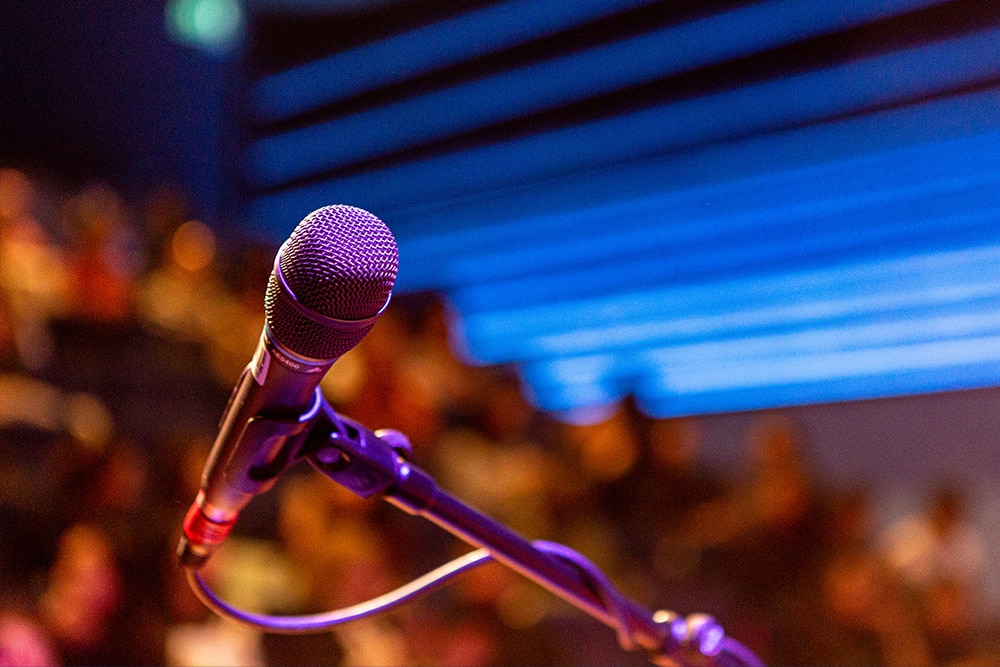
Stand-up comedy has always been a purely verbal art form — the comedian, the microphone, the audience. No sets, no props, no music. The joke lands on its own or it doesn’t. But the comedian’s career beyond the stage is a different matter. The content operation that builds an audience between live shows — the social media presence, the podcast, the YouTube channel, the promotional clips — doesn’t have the same constraints as a live set, and the comedians who treat that content operation seriously are increasingly thinking about audio in ways that comics a generation ago never needed to.
Music in comedy content isn’t about selling out or diluting the craft. It’s about understanding that online content has different mechanics from a live set, and that audio identity is part of how comedians build recognition and brand in a medium that rewards distinctiveness.
A Sonic Identity That Sets the Stage
A comedian’s stage persona is constructed from many elements — delivery, timing, subject matter, the specific relationship with the audience. Online, that persona needs to work without the live room’s immediacy, and it needs to work in the first two seconds of a clip before a viewer has decided whether to keep watching.
Music in opening sequences, in transitions between clips, in the background of talking-head content communicates the comedian’s register before the joke has landed. A deadpan, absurdist comedian sounds different from a high-energy crowd-worker, who sounds different from a confessional storyteller, who sounds different from a sharp political satirist. That difference can be communicated in the audio before a word is spoken.
A free beat maker generates original music from a description of the comedian’s specific comedic register. “Dry, slightly off, the feeling that something is wrong in a way that can’t quite be identified, minimal and suspicious” for an absurdist or deadpan comedian. “High energy, confident, the feeling of someone who is absolutely about to make you laugh whether you’re ready or not” for a crowd-work comedian. “Warm, self-deprecating, intimate, the feeling of someone telling you something embarrassing that’s also very funny” for a confessional comedy style. Each description produces music that communicates the specific comedic world rather than a generic “this is a comedy channel” signal.
Using Familiar Melodies for Comic Effect
Comedy has always had a specific relationship with musical reference — the recognizable tune used in an unexpected context, the serious melody applied to an absurd subject, the familiar song that lands in exactly the wrong moment. This is the core mechanism of musical comedy: the gap between what the music promises and what the content delivers is where the joke lives.
A text to music generates musical pieces from a description of the comedic premise being served. “Triumphant, orchestral, the kind of music that plays when a hero defeats their enemy, completely sincere” to accompany a clip about a mundane personal victory. “Ominous, building dread, something terrible is coming” for a piece about a minor inconvenience being escalated dramatically. “Romantic, sweeping, the feeling of a film’s love theme” for content about something deeply unromantic. The music is generated to commit completely to its emotional premise — which is what makes the contrast with the comedic content funny.
For comedians producing scripted video content, sketches, or any format where music can participate actively in the joke rather than just accompany it, this workflow — describe the comedic musical premise, generate the piece — makes musical comedy production fast enough to use regularly.
Promotional Clips and Special Content
Stand-up specials, festival appearances, club recordings, and album releases are the major release moments in a comedian’s career, and the promotional content around them determines how much of an audience those releases reach. Trailers, clips, announcement posts — all of this promotional content benefits from audio that’s as deliberately chosen as the clips being promoted.
An ai song cover generator is useful for comedians who want to incorporate familiar melodies into their promotional content — taking a well-known song and reinterpreting it with new lyrics that speak directly to the special, the tour, or the comedian’s specific comedic angle. The melody carries immediate recognition; the new words deliver the promotional message or the joke. A tour announcement that uses a familiar tune rewritten with tour-specific lyrics is more memorable and more shareable than a straightforward promotional graphic with text.
For comedians building a consistent brand around a specific musical sensibility — comics who incorporate music regularly into their live shows or who have a distinct relationship with a particular genre or era of music — the cover generator allows that sensibility to travel into promotional content in a form that’s legally clean and brand-specific rather than borrowed from a licensed original recording.